THE MUD ISN'T THE STORY. THE LEASE IS.
Soaring interest rates, 50% insurance spikes, and rent control caps are freezing out individual housing investors while politicians claim to solve affordability.


Austin rents its crown-jewel park to a Live Nation subsidiary for about $103,500 a year. The same promoter pays Chicago $10 million. The contract runs to 2040.
🗺️ Current Dispatch: Austin, Texas
⛽ Local Diesel: $6.24/gal
☕ Diner Coffee Index: $2.75 — South Lamar, strong, served next to two people scraping their boots. 7/10.
A PUBLIC ASSET, PRICED LIKE A PARKING SPOT
The Great Lawn at Zilker looks like a plowed field. People are walking out of there barefoot, carrying their shoes.
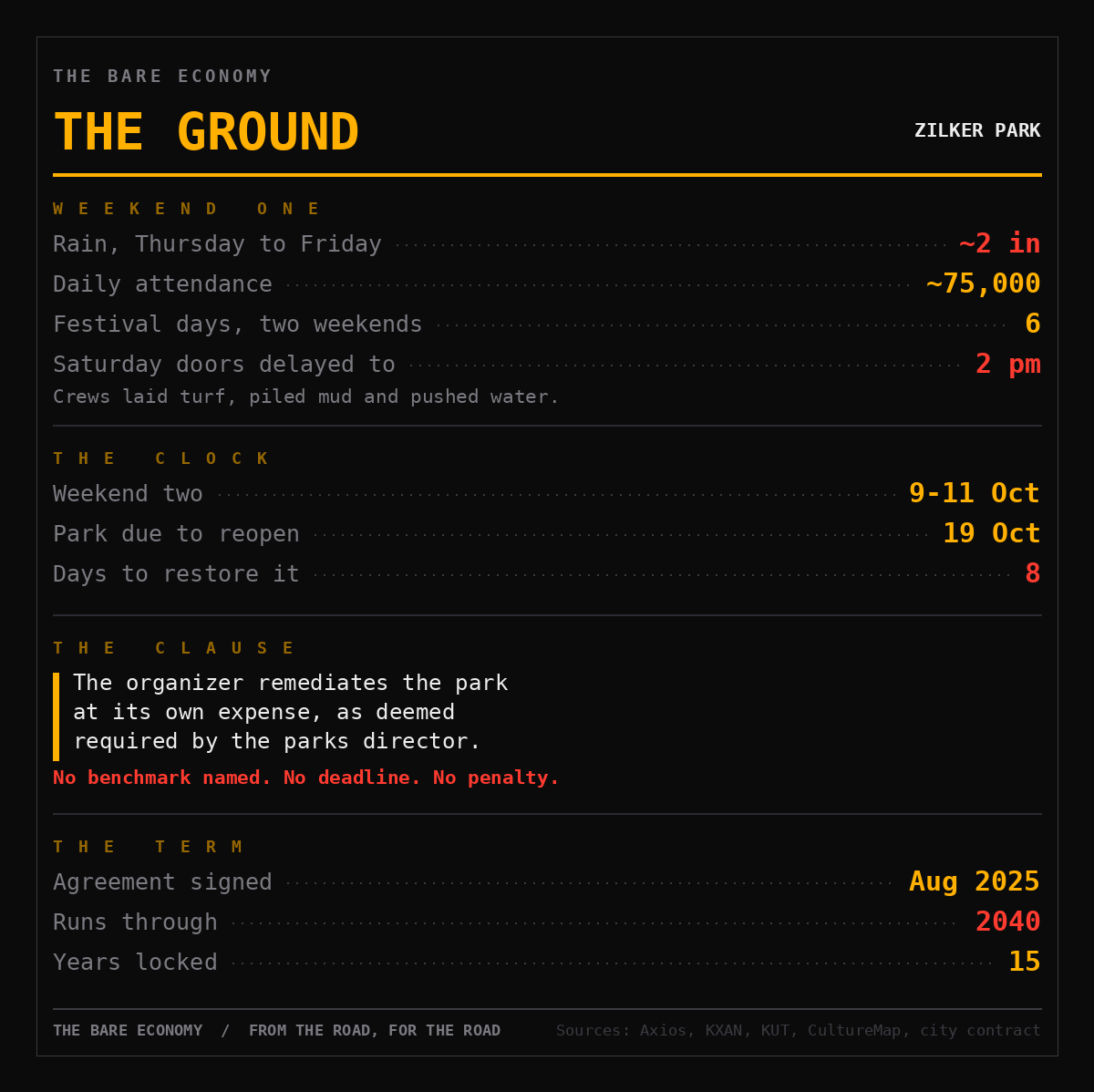
Rain hit Thursday and Friday, organizers delayed Saturday's doors by two hours to push water and lay turf, and roughly 75,000 people a day walked across soaked ground anyway.
The council member for that district, Ryan Alter, called the damage unacceptable. His November opponent has already made the mud a campaign issue.
But the mud is weather. The contract is a choice.
The Tax Mistake Most Retirees Make Without Knowing (AD)
Hello,
Most Americans don’t realize they’re losing money to taxes until it’s too late.
Not because they cheated. Not because they were reckless.
But because the rules changed — quietly.
With tax laws shifting in 2026 and Washington rewriting retirement policy, doing nothing could mean paying more than you expected later.
There is a simple retirement move many people overlook — one that may help reduce future taxes and prevent unpleasant surprises.
This free guide explains what’s changing and how prepared savers are adjusting before tax season hits.
Get the free guide now — before the window closes.
THE BREAKDOWN: WHAT AUSTIN ACTUALLY CHARGES
1. The remediation clause exists and it is discretionary.
The 2025 agreement says the organizer will remediate the property at its own expense, as deemed required by the city's parks and recreation director.
Read that again. The standard is whatever one appointed official decides it is. There is no specified restoration benchmark in that sentence, no deadline, and no penalty named.
2. The direct payment to the city is small.
Austin Free Press reported that C3 Presents paid the City of Austin about $103,500 a year in 2024 and 2025 for use of Zilker Park.
The same company, a Live Nation subsidiary, paid the City of Chicago $10 million in 2024 to run Lollapalooza in Grant Park, plus $2 million to Chicago public schools.
3. The real money goes to a nonprofit, not the city.
In 2024 the Austin Parks Foundation received about $8.4 million from the festival, roughly 81 times what the city collected directly. Last year's figure was $8.5 million.
Since 2006 the festival has allocated nearly $71 million toward improvements at Zilker and other Austin parks. That is real money doing real work. It is also money that flows through a private foundation rather than a public budget, which means it is not appropriated, not voted on, and not subject to the same scrutiny as a line item.
4. The lock runs fifteen years.
The city signed the extension in August 2025 and it runs through the end of 2040, with dates set at on or about the first two weekends of October.
Austin has now committed the first two weekends of October at its signature park, every year, until today's toddlers can vote.
While Bitcoin Explodes, Smart Money Eyes This Coin (AD)
THE FRICTION: SAME COMPANY, TWO CITIES
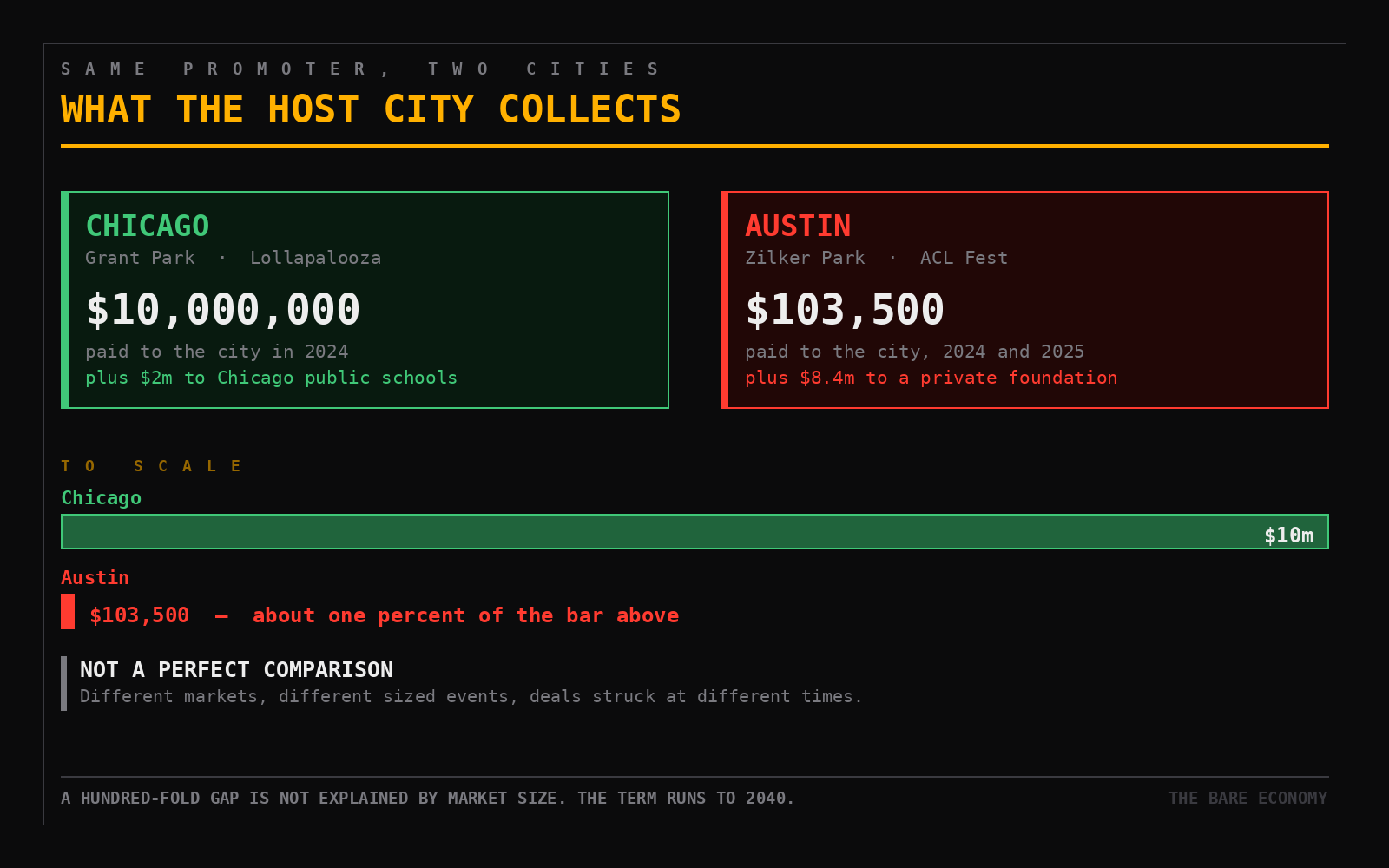
The defense of the Austin structure is not weak and I will put it properly. Foundation money is earmarked for parks and cannot be swept into a general fund to plug a budget hole. Nearly $71 million has gone into Austin park improvements since 2006. The festival's boosters claim roughly half a billion dollars of citywide economic activity, and hotels, restaurants and bars in that corridor are not imagining their October.
Chicago is also not a clean comparison. Grant Park sits in a bigger market, Lollapalooza is a bigger property, and the deals were negotiated at different times under different leverage.
What survives all of that is the ratio. A hundred-fold gap between what one city charges and what another charges for the same company's festival is not explained by market size. Somebody on the Austin side priced this, and the fifteen-year term means nobody gets to reprice it until 2040 no matter how many lawns get destroyed.
The mud made people look. That is usually how a lease gets read.
“I Moved My 401(k) Into Gold. My Accountant Called It a Disaster.” (AD)
It happens more than most people realize.
Someone hears about gold. They do their research. They call a gold company, move their retirement funds, and feel good about the decision.
Then tax season arrives.
They open a letter from the IRS and find out their account was never eligible for a tax-deferred rollover in the first place.
Now they owe tens of thousands of dollars in taxes and penalties — on money they thought they were protecting.
The gold company moved fast. Nobody stopped to check eligibility first.
Before you move a single dollar of your retirement into gold, there is one question you need answered: does your account actually qualify?
That is exactly what the Retirement Metals Readiness Report was built to answer.
It takes two minutes. It is completely free. And it gives you a straight answer in plain English — whether your 401(k), IRA, or TSP is eligible for a gold rollover, and whether you will owe any taxes or penalties.
You also receive a personalized gold and silver mix based on your specific goals and risk tolerance, and a step-by-step rollover checklist so you know exactly what to do next.
A Gold IRA specialist is standing by to answer any questions — free of charge.
→ Take the Free 2-Minute Eligibility Check
Two minutes now could save you thousands later.
Sincerely,
Anchor Point Research
P.S. Gold surged 64% in 2025 — but only those who moved correctly kept every dollar of it. Find out if your account qualifies before you act. Check My Eligibility — Free
THE MACRO EXTRACTION
This is the municipal version of a pattern this newsletter has been chasing all month. A private operator gets long-dated access to a public asset, the upside is contractual and specific, and the cost of damage is governed by a clause that says somebody will decide later what is required.
It is the same shape as the data center that gets a power hookup while the residential rate case comes later, and the same shape as a chatbot answering Medicare questions with nobody named as liable when the answer is wrong. The asset is public. The revenue is private. The remediation standard is a judgment call.
If you own property, run a business, or vote anywhere near a venue like this, the thing to read is not the economic impact study. It is the term sheet. Ask what the host government collects directly, what flows to a nonprofit instead, how long the term runs, and what happens if the operator leaves the place worse than it found it.
Those four questions take ten minutes against a public contract and they tell you more than any attendance figure.
Zilker is supposed to reopen on the nineteenth. If it does not, Austin will learn exactly what its remediation clause is worth, which is the only real test any of these agreements ever gets.
Keep your capital guarded, hold your ground, and stay sharp out there.
— Brook
The Bare Economy. From the road. For the road.