NOBODY IS GETTING FIRED. NOBODY IS GETTING HIRED EITHER.
Soaring interest rates, 50% insurance spikes, and rent control caps are freezing out individual housing investors while politicians claim to solve affordability.


48% of Americans are very worried people can’t find work, the highest Pew has recorded. Layoffs are near 1960s lows. Both of those are true, and the gap between them is the whole story.
FIVE DAYS AGO THE QUESTION WAS WHY. PEW JUST ANSWERED IT.
The staffing office on North General Bruce Drive opens at eight. There were six people outside it at ten to.
Goldman told clients last Friday that consumer sentiment was subdued for reasons beyond cost of living, and did not say what the reasons were. Pew published the answer the day before, and nobody connected them.
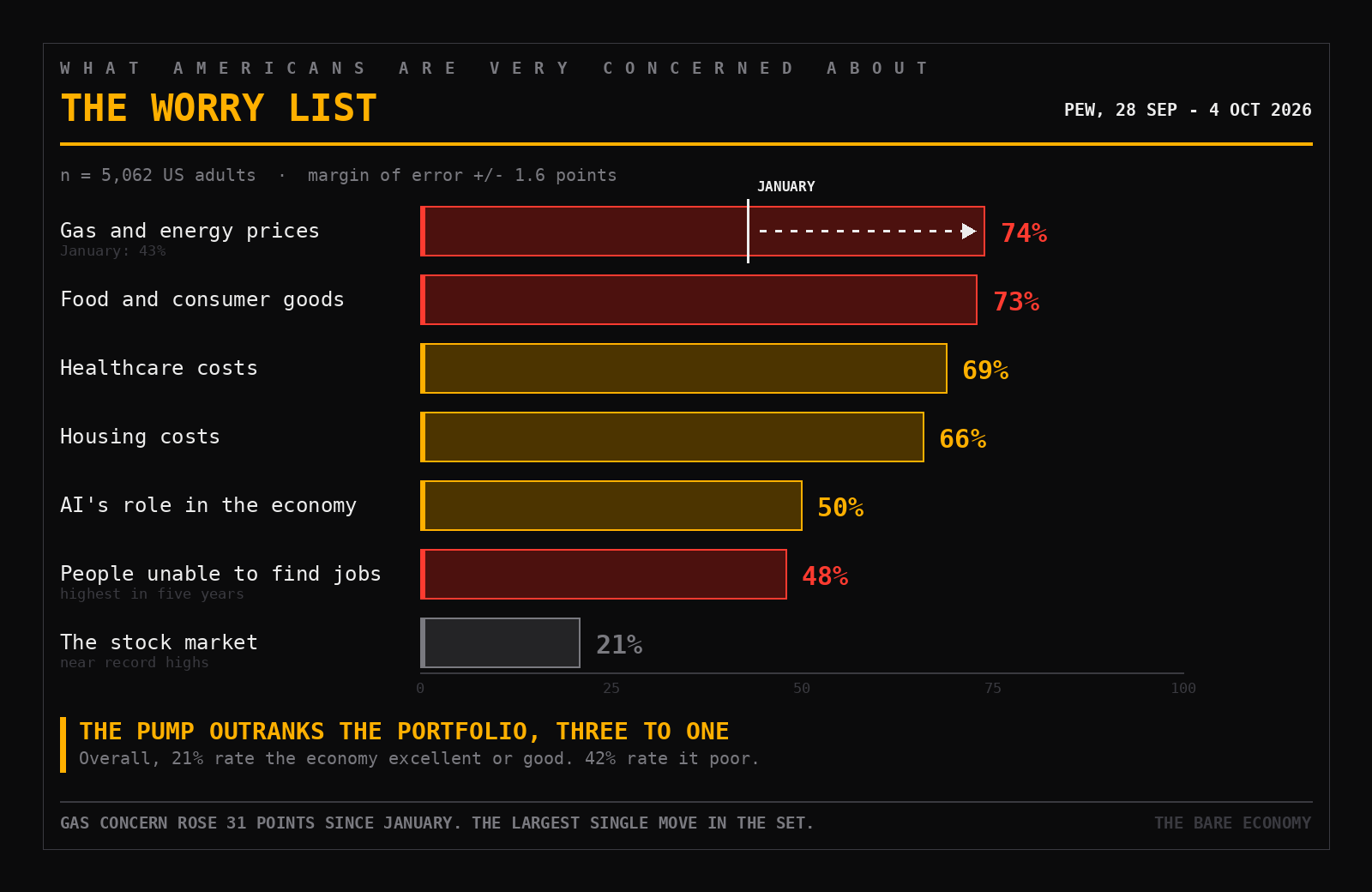
Seventy-four percent worried about fuel. Twenty-one percent worried about the stock market, which is near records.
That is not a mood. That is a correct reading of where the damage is.
[viral video] Elon’s Phone finally out? (AD)

Starting Wednesday, October 21, Elon Musk is about to reveal his 'iPhone' — a breakthrough he says will be "10x bigger than the largest product in history."
Click to watch this exclusive sneak preview now, before it is pulled from the internet.
THE BREAKDOWN: THE FEAR IS RUNNING AHEAD OF THE DATA
1. Job anxiety is climbing on a clean trend line.
The share very concerned that people who want work cannot find it: 29% in October 2022, 40% in September 2024, 42% in September 2025, 45% in January, 44% in July, 48% now.
That is not a blip. It is a five-year climb, and it is the highest reading since Pew began asking.
2. The hard data says the opposite, and that matters.
Jobless claims have run below 200,000 for a month, a stretch rarely seen since the 1960s. If you hold a job in this economy you are about as unlikely to lose it as at any point in sixty years.
The New York Fed’s September survey makes the same point from the household side. The perceived probability of losing your job in the next year fell to 13.5%, the lowest since December 2024. Expectations of rising national unemployment also fell.
3. The number everyone is quoting deserves a closer look.
The widely cited figure is that Americans put their odds of finding work at 46% if they lost their job. True, and worth two caveats most coverage skipped.
It rose 0.7 points last month, and at 46.1% it sits above its twelve-month average of 45.5%. The direction is up, not down. Low in absolute terms, improving at the margin.
4. Watch the gap between personal and general.
Personal job security is improving. Confidence in the labor market as a thing is deteriorating. Those are different questions and people are answering them differently.
That gap usually means the fear is arriving through the news rather than through the paycheck. Half of Americans are now very concerned about AI’s role in the economy, and the reporting so far suggests AI is not yet taking jobs at scale. The anxiety is running ahead of the displacement.
Two Men Shocked by What This Tesla Did (AD)
This Tesla Demo Shocks Everyone
"Hi, I'm Jeff Brown...I'm about to get in this Tesla and let it take me a few miles to show you Elon Musk's next Big Project today…
What happens next will shock you…"

Click here to see what happened.
THE FRICTION: TWO LABOR MARKETS, ONE COUNTRY
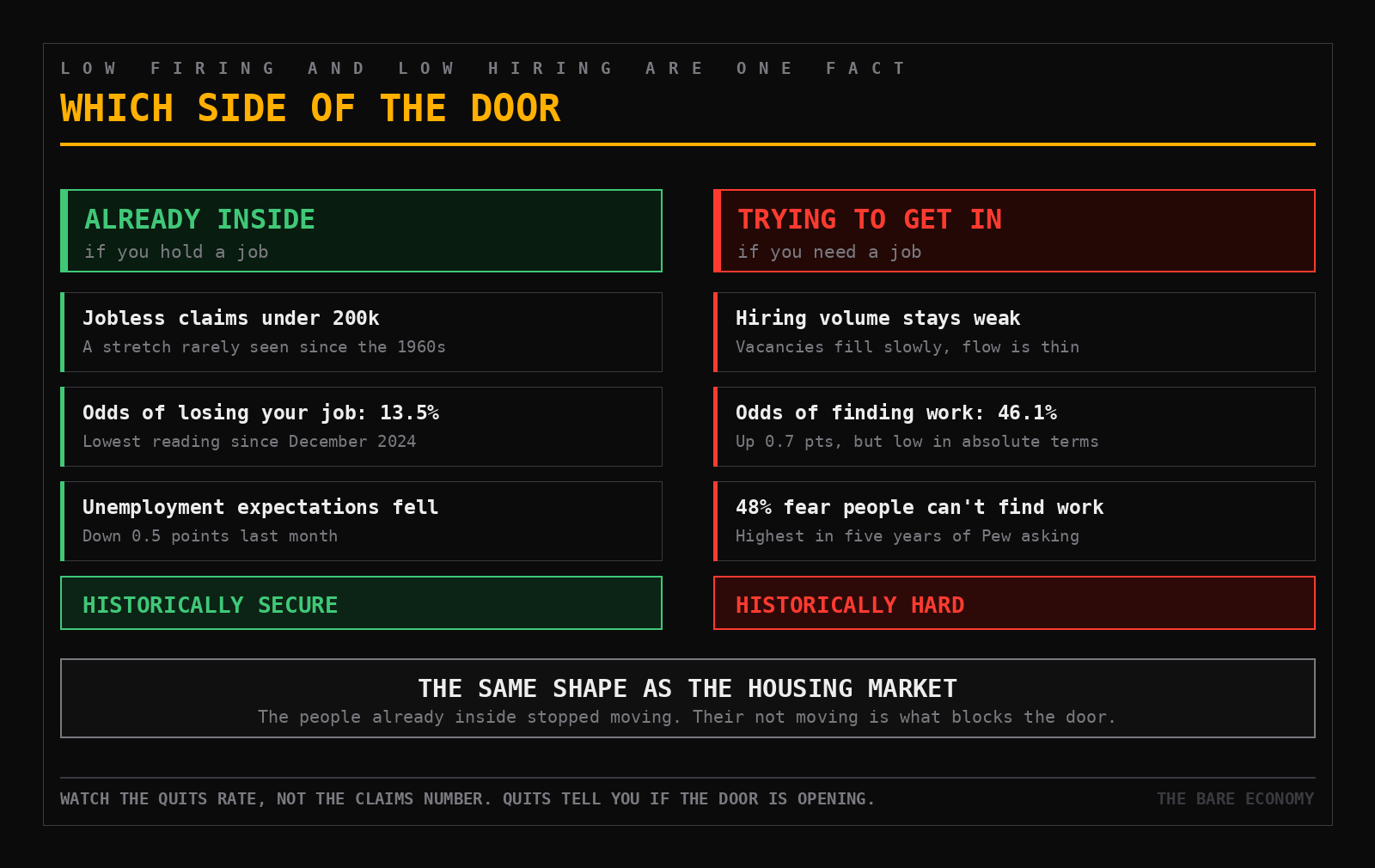
This is the same shape as the housing market, and once you see it you cannot stop seeing it.
Lock in a 3% mortgage and you are fine, and you will never sell. Need to buy a house and you are frozen out at 7%. Hold a job and you are safer than at almost any time since the sixties. Need a job and you are looking at a 46% shot.
In both markets the people already inside are doing well and have stopped moving, and their not moving is exactly what blocks the door. Low firing and low hiring are the same fact, not two facts.
The partisan read is worth stating honestly because it cuts both ways. Overall economic ratings are heavily partisan: 36% of Republicans call the economy excellent or good against 9% of Democrats. But look at the gas and energy number, 65% of Republicans very concerned and 81% of Democrats. On the thing actually hitting household budgets, both sides largely agree. The disagreement is about who to blame, not about what is happening.
Airbnb started with 3 guests. This outdoor brand has hosted 1M+ (AD)
Airbnb Proved Travelers Will Sleep Differently
In 2007, Airbnb started with three guests sleeping on airbeds in a San Francisco apartment.
Thirteen years later, Airbnb went public at $68/share.
The lesson?
Travelers will choose something other than a traditional hotel when a new format better fits the trip.
And another shift may already be underway.

America’s national parks saw 323M+ visits in 2025. Meanwhile, Airbnb says searches for stays near U.S. national parks are up 35% in 2026.
That’s exactly where AutoCamp built its business:
Hotel-grade Airstreams and cabins near destinations like Yosemite, Zion and Joshua Tree.
AutoCamp says it has already welcomed 1M+ guests across 8 properties and generated $150M+ in lifetime lodging revenue.
Now, everyday investors can invest in AutoCamp at $9.10/share.
Deadline to invest: Thursday, October 29.
| Become an Early-Stage AutoCamp Investor by 10/29 |
This is a paid advertisement for AutoCamp Regulation Crowdfunding offering. Please read the offering circular at invest.autocamp.com
THE MACRO EXTRACTION
If you have a job, the implication is uncomfortable and simple: your leverage is lower than your security suggests. A market with low firing and low hiring is one where staying put is safe and leaving is expensive, which is precisely the condition under which employers stop needing to raise your pay. Secure is not the same as strong.
If you are looking, the useful fact is that the weakness is in hiring volume rather than in firing. Vacancies exist, they just fill slowly and the process grinds. That argues for patience and for networks over applications, because a thin-flow market rewards people who hear about the opening before it posts.
For the macro question, the number to track is the quits rate rather than the claims number. Claims tell you about firing, which is the part that looks healthy. Quits tell you whether people believe they can get something better, and that belief is what actually restarts a frozen market.
And one note on the gas line. Concern jumped from 43% in January to 74% now, the largest single-survey move in the whole Pew set. That is the diesel shock this newsletter has been tracking since September, arriving in the polling with about a one-month delay, exactly where the delay line said it would.
Keep your capital guarded, hold your ground, and stay sharp out there.
— Brook
The Bare Economy. From the road. For the road.