The Bank That Didn’t Watch Trillions Gets a Three-Week Fine
Soaring interest rates, 50% insurance spikes, and rent control caps are freezing out individual housing investors while politicians claim to solve affordability.


$1.2 billion, the largest penalty in OCC history, for failing to monitor transactions regulators say included Chinese laundering networks and border trade fraud. Nobody was charged.
THE PAPERWORK RAN ONE WAY
The woman ahead of me at the branch on Old Brandon Road spent eleven minutes explaining a $4,000 deposit. Invoice, contract, two forms of ID.
Her bank is the one Treasury just fined for not reviewing trillions.
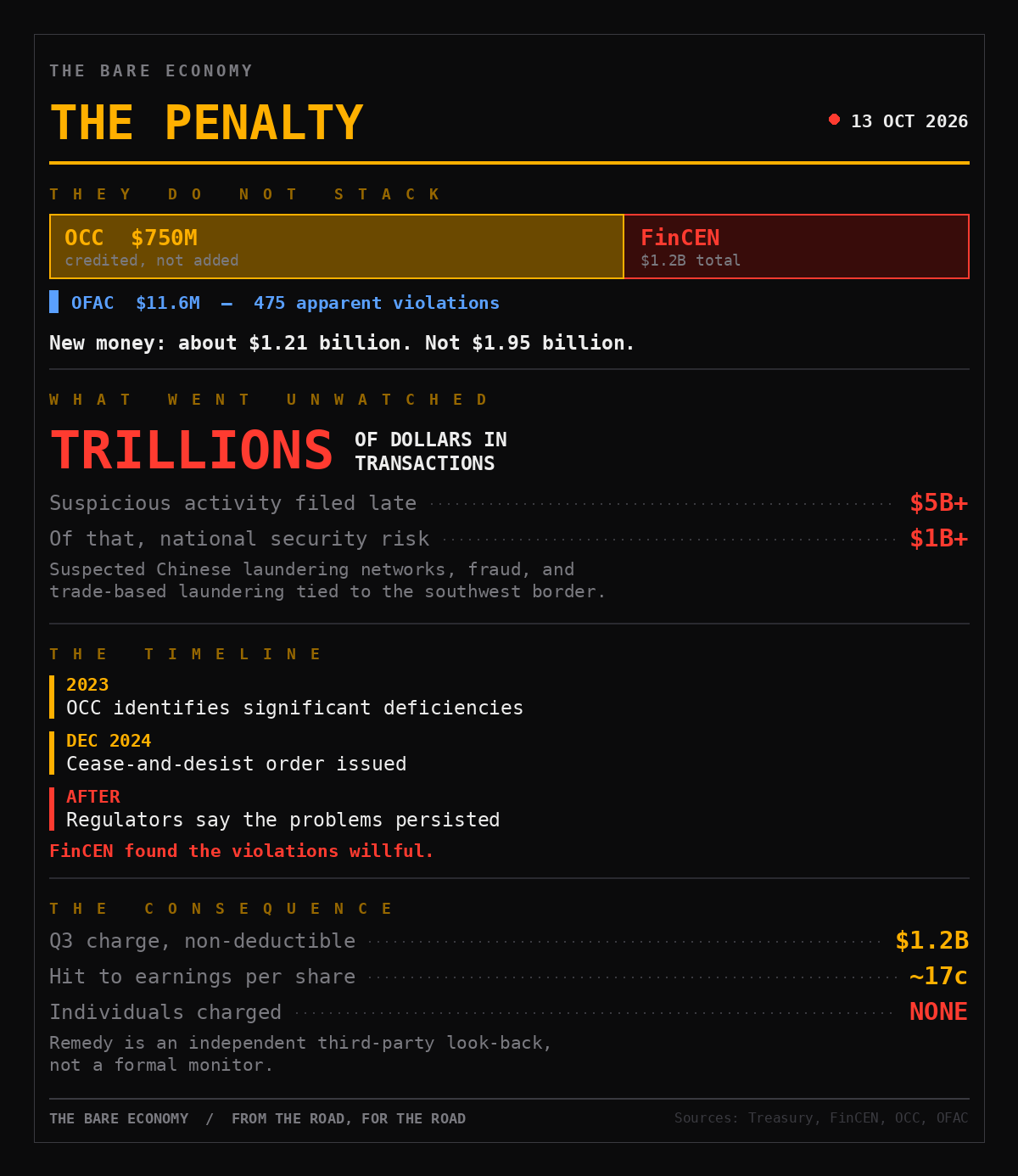
Read the structure before the headline. The FinCEN penalty includes credit for the OCC’s $750 million. These do not stack into two billion. The new money is about $1.21 billion.
Days Left: The NVIDIA Robot Behind a $4B Opportunity (AD)
Why’s This NVIDIA Collaborator Robot Called Flippy? (Invest Now)
We all see robots flipping on social media. But a french-fry robot named Flippy? That doesn’t make sense.
Miso Robotics' share price jumps in days — this is your last shot at today's price, has heard it all before.
But ask restaurant operators in the $1T fast-food industry like White Castle who deploy Miso’s Flippy Fry Station robot, and it sure makes a lot more sense.
Flippy FLIPS restaurant operator’s bottom lines, helping boost a location’s profits up to 4X.
And with Miso having a $4B/year US revenue opportunity for just the fry station alone and a special collaboration with NVIDIA, these french fries are way beyond small potatoes.
Right now — while everyone else is just talking about AI robots — Flippy is already flipping fries at White Castle, Jersey Mike's, and Cinnabon. This window won't stay open.
After Miso recently acquired two major new product assets, Flippy has become the star of a rapidly expanding ecosystem. Customers think of what Miso is building as the operating system for modern restaurants.
Miso just added big-name customers like Jersey Mike’s and Cinnabon… and grew its patent portfolio by ~10X to 300+. On top of that, their robots even started entering college campuses, NBA arenas, and a new national burger chain.
Over 44,000 everyday investors have already claimed their stake. Every day you wait is a day someone else takes your spot. This isn't a "someday" — it's right now. The $5.60 price is gone for good.
Days left. $5.60/share is a price you won't see again. Get in while the window's still open.
Miso Robotics is offering securities through the use of an Offering Statement that has been qualified by the Securities and Exchange Commission under Tier II of Regulation A. A copy of the Final Offering Circular that forms a part of the Offering Statement may be obtained from: invest.misorobotics.com/
THE BREAKDOWN: WHAT REGULATORS SAY HAPPENED
1. The failures were known and continued anyway.
The OCC identified significant deficiencies in 2023 and issued a cease-and-desist order in December 2024. Regulators say the problems persisted after that order.
FinCEN found the violations willful under the Bank Secrecy Act. That word is doing heavy work. Willful is not the same as sloppy.
2. The regulators named a motive.
Officials said the bank “prioritized revenue while limiting compliance resources.” That is unusually direct language for an enforcement release, and it describes a budget decision rather than an accident.
Treasury Secretary Scott Bessent framed it as a message that “even the biggest financial institutions are not above the law.”
3. What sat inside the unmonitored flow.
More than $5 billion in suspicious transactions were reported late. Of that, more than $1 billion involved national security risk, including suspected Chinese money laundering networks, fraud, and possible trade-based laundering tied to the southwest border.
The separate OFAC settlement covers 475 apparent violations touching Iran, Russia, Belarus, Burma, Somalia, narcotics trafficking and global terrorism, including processing payments through sanctioned banks and delaying watchlist updates.
4. The remedy is a review, not a monitor.
The bank must engage an independent third party to look back at previously undetected suspicious transactions, plus further reviews of its controls and added compliance commitments on the sanctions side.
No individuals have been charged in the reporting so far. The cost lands as a $1.2 billion non-deductible charge in the third quarter, about 17 cents a share.
Two Men Shocked by What This Tesla Did (AD)
This Tesla Demo Shocks Everyone
"Hi, I'm Jeff Brown...I'm about to get in this Tesla and let it take me a few miles to show you Elon Musk's next Big Project today…
What happens next will shock you…"

Click here to see what happened.
THE FRICTION: WHO ACTUALLY PAYS A CORPORATE FINE
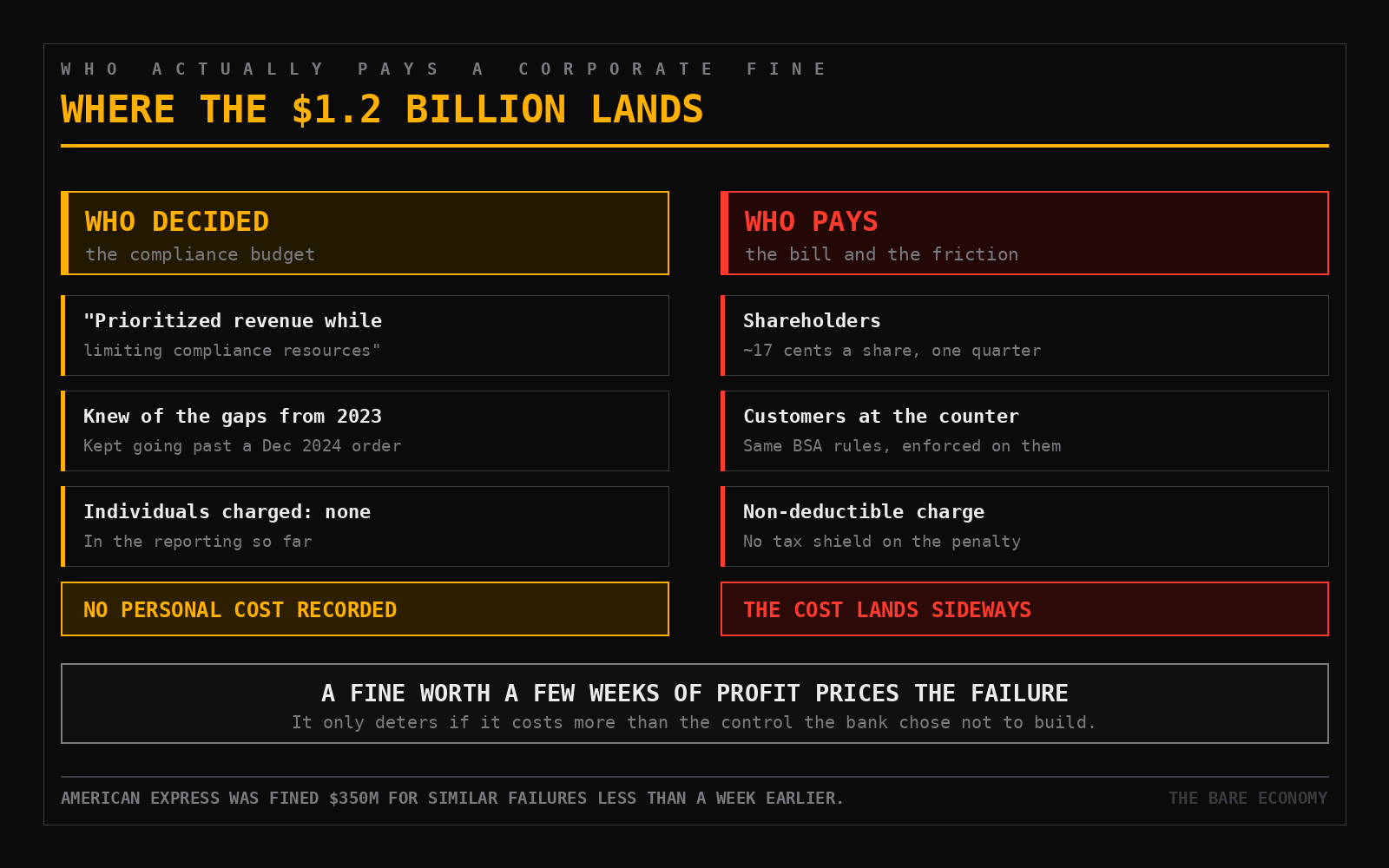
The bank’s defense deserves a fair hearing, because parts of it are true. Bank of America says it has spent billions on technology and assigned thousands of employees to financial crime work, has cooperated with regulators and made substantial progress. Monitoring a transaction flow at this scale genuinely is hard, the false-positive rate on these systems is brutal, and over-flagging has its own victims: ordinary customers and small businesses who get accounts frozen or closed because an algorithm did not like a pattern.
That is a real cost and it is why nobody serious wants banks flagging everything.
What the defense does not answer is the sequence. Deficiencies identified in 2023, a cease-and-desist in December 2024, problems continuing after. At some point “hard” stops explaining it.
Then there is the arithmetic that makes compliance officers tired. Bank of America earns several billion dollars in a typical quarter. A $1.2 billion charge is real money and it is also roughly a few weeks of profit. If building the monitoring system properly over those years would have cost more than that, the fine did not change the calculus, it priced it.
HORRIBLE News Comes in for US Retirees (AD)
A law Congress passed is starting to make its presence felt…
And that’s VERY bad news for retirees.
Even the Wall Street Journal had to admit that the law…
“Upends 20 Years of Retirement Planning and STICKS It to the Middle Class.”
What does that mean for you?
It’s time to find out…
But prepare to be SHOCKED.
Click here to find out how this law will affect you...
Before it has everyone in its crosshairs.
THE MACRO EXTRACTION
If you hold bank stocks, the signal is the sequence rather than the single number. American Express was fined $350 million for similar failures less than a week before this. Two enforcement actions on compliance programs inside seven days is a posture, not a coincidence, and the next large bank to disclose a BSA charge should not surprise anyone holding the sector.
Price the charge the way the bank does. One quarter, 17 cents a share, non-deductible so no tax shield. That is a dent, not a solvency event, and anyone selling you a bank collapse story off this headline is overreading it.
The pattern worth filing is the one this newsletter has hit four times in a month. Chips lent against with no agreed shelf life. An AI accord with no statute behind it. School districts buying software that does not read the books. Now a bank that did not watch trillions. In each case a control was expensive, the cheap version got bought or skipped, and when it failed the cost landed on people who never made the decision.
And hold onto the teller window. The reporting requirements that cost that woman eleven minutes on a $4,000 deposit are the retail end of the same Bank Secrecy Act. The obligation is identical. Only one side of the counter got audited on it.
Keep your capital guarded, hold your ground, and stay sharp out there.
— Brook
The Bare Economy. From the road. For the road.