BREAKING: California And Louisiana Just Posted The Same Poverty Rate
Soaring interest rates, 50% insurance spikes, and rent control caps are freezing out individual housing investors while politicians claim to solve affordability.


One has an income problem. The other has a cost problem. The national number buries both.
JUST IN: THE SABINE RIVER IS WORTH 7.1 POINTS
Crossed out of Texas on I-10 at six this morning and watched the sign prices fall for forty miles. Diesel down twenty-three cents from Austin. A motel room here for what a parking space runs in Oakland.
Then the Census Bureau put out a map saying the people on this side of the river are poorer than the people on that side.
Both things are true at once. That gap is the whole story.
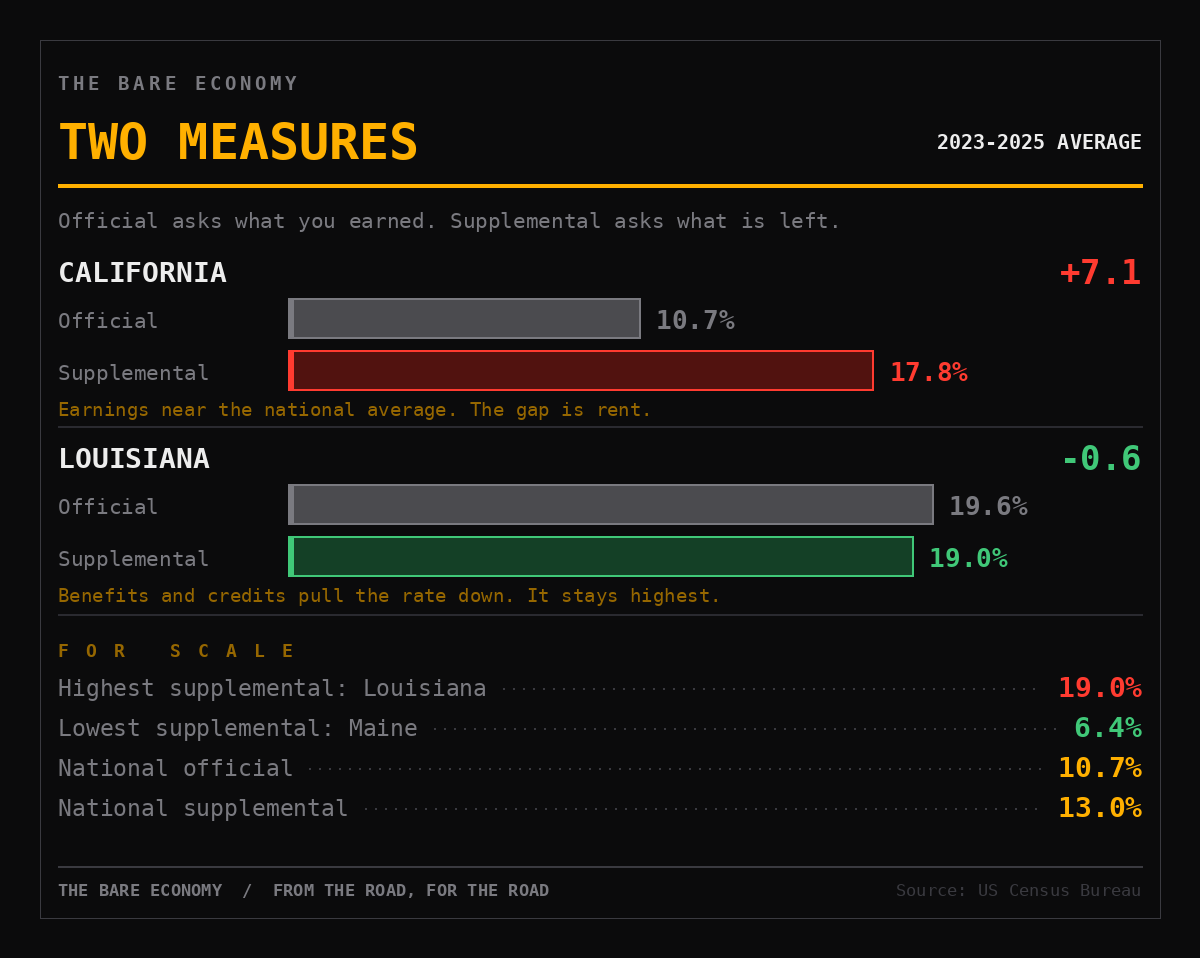
The official poverty line asks one question. What did you earn before taxes? The supplemental measure asks a harder one. What did you earn, what did the government add, what did taxes and commuting and medical bills take back out, and what does a roof cost where you actually sleep?
Ask California both questions and the answer moves from 10.7% to 17.8%. Ask Louisiana and it moves from 19.6% down to 19.0%.
Same destination. Opposite roads.
You know Starbucks. Do you know this company? (AD)
Everyone knows Starbucks now.
In June 1992, the story was still unfolding.
The company went public at $17 a share. Adjusted for later stock splits, that works out to about 27 cents.
Looking back is easy.
Evaluating a business while its story is unfolding takes a closer look.
Starbucks’ history does not predict another company’s returns. But it gives us a reason to look beyond the coffee cup.
Take Green Coffee Company.
Still private. Offering shares at $1.15.
As of October 2026, the company reports:
45 Colombian coffee farms.
Products in more than 3,000 North American retail stores.
Those stores carry its products; they are not company-owned cafés.
There’s a business behind these numbers: coffee grown on its farms, processed, and brought to retail shelves.
The coffee is already on shelves.
The company is still private.
Take a closer look at how Green Coffee Company operates, what it sells, and the terms of its offering.
Explore Green Coffee Company’s $1.15 offering →
This is a paid advertisement for Green Coffee Company's Regulation A offering. Please read the offering circular at https://invest.greencoffeecompany.com/. Timelines are subject to change. Listing on the NASDAQ is contingent upon necessary approvals, and reserving a ticker symbol does not guarantee a company's public listing.
THE BREAKDOWN: WHAT THE SECOND QUESTION FINDS
1. California’s number is a rent number. Its official rate, 10.7%, sits exactly on the national average. Nothing remarkable. Then you price the housing and it jumps nearly two-thirds, the largest gap of any state. Those people did not get poorer between the two measurements. The measurement finally looked at what they pay to stay indoors.
2. Louisiana’s number is a wage number. It goes the other way, and that detail did not make the map’s headline. SNAP, housing assistance and refundable tax credits pull enough households above the line to drop the rate six-tenths of a point. Cheap housing helps too. The state still finishes with the highest supplemental poverty rate in the country. The help is real and it is not enough, because what it is compensating for is the income underneath.
3. The map says 37 states. The Census Bureau says 26. The map counts every state where the supplemental number is arithmetically bigger. The Bureau’s own writeup counts only the 26 states and D.C. where the difference clears statistical significance, with five states significantly lower and 19 too close to call. Both counts come from the same table. One of them is a coin flip dressed as a finding.
4. The South did not leave the top of the list. The Census story on this exact data is headlined “States With Highest Poverty Rates Clustered in the South.” Ten of the eleven states significantly above the national official rate are Southern. Louisiana holds the worst supplemental rate in America. The divide did not dissolve. California climbed into it.
Elon just asked for 1,000,000 satellites (AD)
On January 30th, Elon quietly filed a document with the FCC.
It asks permission to launch 1,000,000 satellites.
Bloomberg confirmed it.
SpaceX has about 10,000 in orbit today. That took 20 years.
Now Elon wants 100 times more.
Not for internet.
For AI data centers in space.
SpaceX calls it "the largest actionable total addressable market in human history."
There's just one thing Elon can't build himself.
The chip that runs every satellite.
One small public company owns that design. Elon pays it on every chip.
1,000,000 satellites could mean a 100X bigger bill.
Dylan believes this stock takes off October 24th.
One FCC filing proves it. See the ticker here >>
The Buck Stops Here,
Kelly Maguire
Behind the Markets
P.S. You don't need to be a SpaceX insider. You can own this one in any brokerage account.
Get in before October 24th here >>
THE FRICTION: TWO PROBLEMS WEARING ONE NUMBER
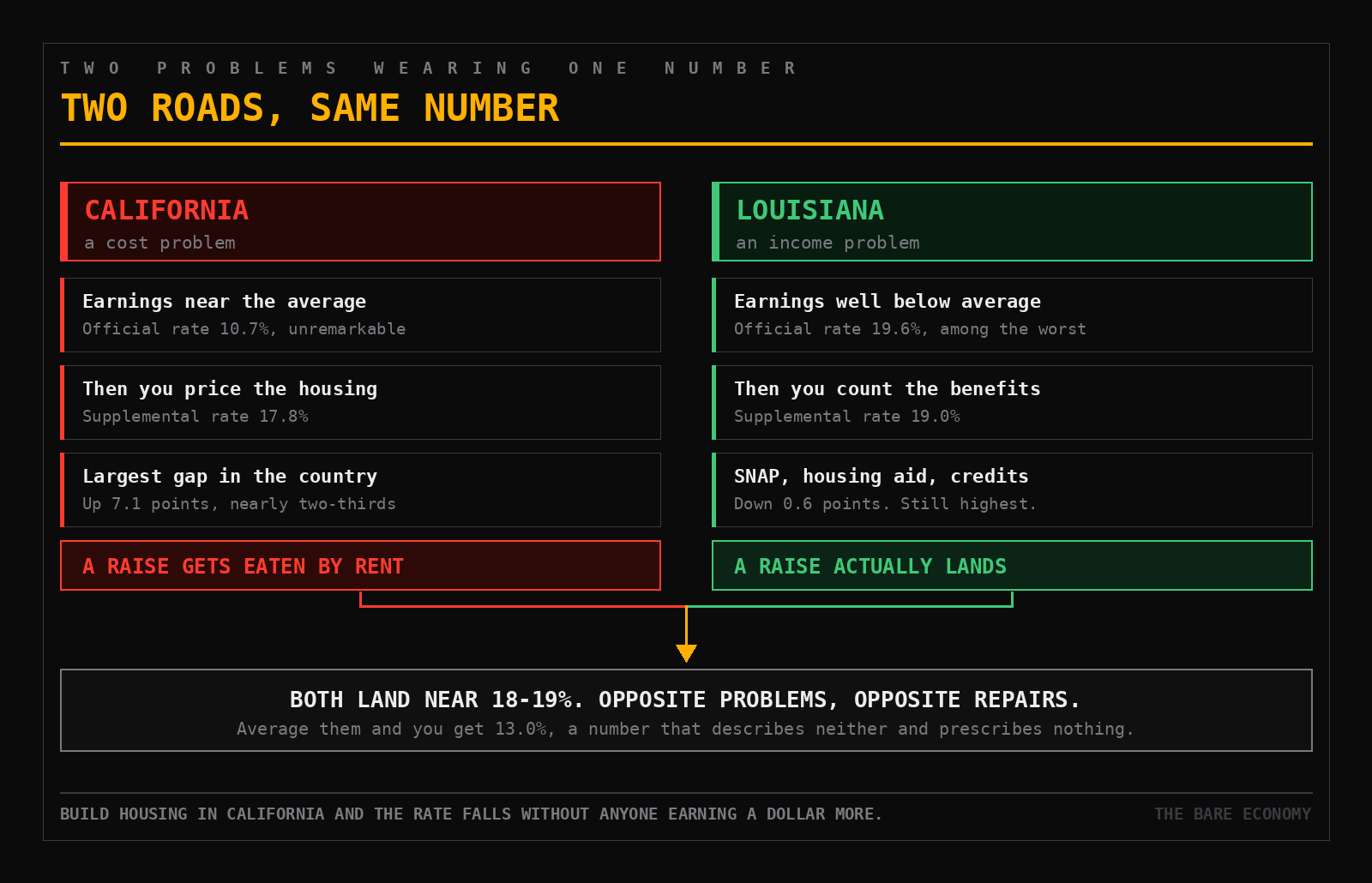
A raise fixes Louisiana. A raise in California gets absorbed by the rent before it reaches the grocery store. Build enough housing in California and the rate falls without anyone earning another dollar. Build housing in Lake Charles and you have built housing nobody needed.
Average the two together and you get 13.0%, a national figure that describes neither state and prescribes nothing.
Saudi families get $3,600/month just for existing. Americans get nothing. (AD)
Saudi families collect $3,600 a month from their government.
No work. No application. No strings.
Just oil money — distributed to citizens automatically.
Here's what nobody tells you:
America has 40% more oil than Saudi Arabia.
More recoverable oil than any nation on earth.
And yet while the Saudis are getting checks — you're getting nothing.
That's about to change.
There's a way for ordinary Americans to tap directly into the $300+ billion generated from American oil and gas every year.
No accreditation required. No Wall Street middleman.
Robert Kiyosaki calls it the Patriot Income Plan.
It has historically paid 8–10% a year. On your terms. Not theirs.
See how to enroll →
THE MACRO EXTRACTION
The official rate fell for a third straight year, to 10.2%. Median household income hit a record $87,460. Child poverty touched a record low on the official measure. Every one of those is real.
The supplemental rate did not move. It sat at 13.1%, nearly three points above the official one, because the thing it measures did not improve.
I have spent this month watching that gap from the driver’s seat. Diesel at $5.94 in Austin. Mortgages stuck near 7%. Seventy-four percent of Americans telling Pew they are very concerned about the price of gas, 73% about groceries, while 21% worry about a stock market sitting at record highs. The official numbers kept getting better and the people kept saying it did not feel like it.
They were not confused. They were using the second measure.
The waitress here refills the chicory without being asked and the room was $54. By California’s threshold she is doing fine. By her own, she is working a double on a Monday.
The line moved. She didn’t.
— Brook
The Bare Economy. From the road. For the road.