THE CATTLE GATE OPENED TODAY. YOUR STEAK DIDN'T GET CHEAPER
Soaring interest rates, 50% insurance spikes, and rent control caps are freezing out individual housing investors while politicians claim to solve affordability.


The biggest livestock crossing on the Mexican border reopened this morning after nearly two years shut. Here is the arithmetic nobody at the ribbon-cutting read out loud.
JUST IN: Seven Hundred Head Against A Seventy-Five-Year Hole
The pens off Pete V. Domenici Highway filled before sunrise for the first time since late 2024. Trucks idled back toward the line. A man who hauls for a Chihuahua outfit told me half the ranchers he used to load for are not in business anymore.
Santa Teresa reopened this morning. It is the biggest livestock inspection port on the border, and it handled 43% of all Mexican cattle coming into this country over the past five years.
It will process about 700 head today.
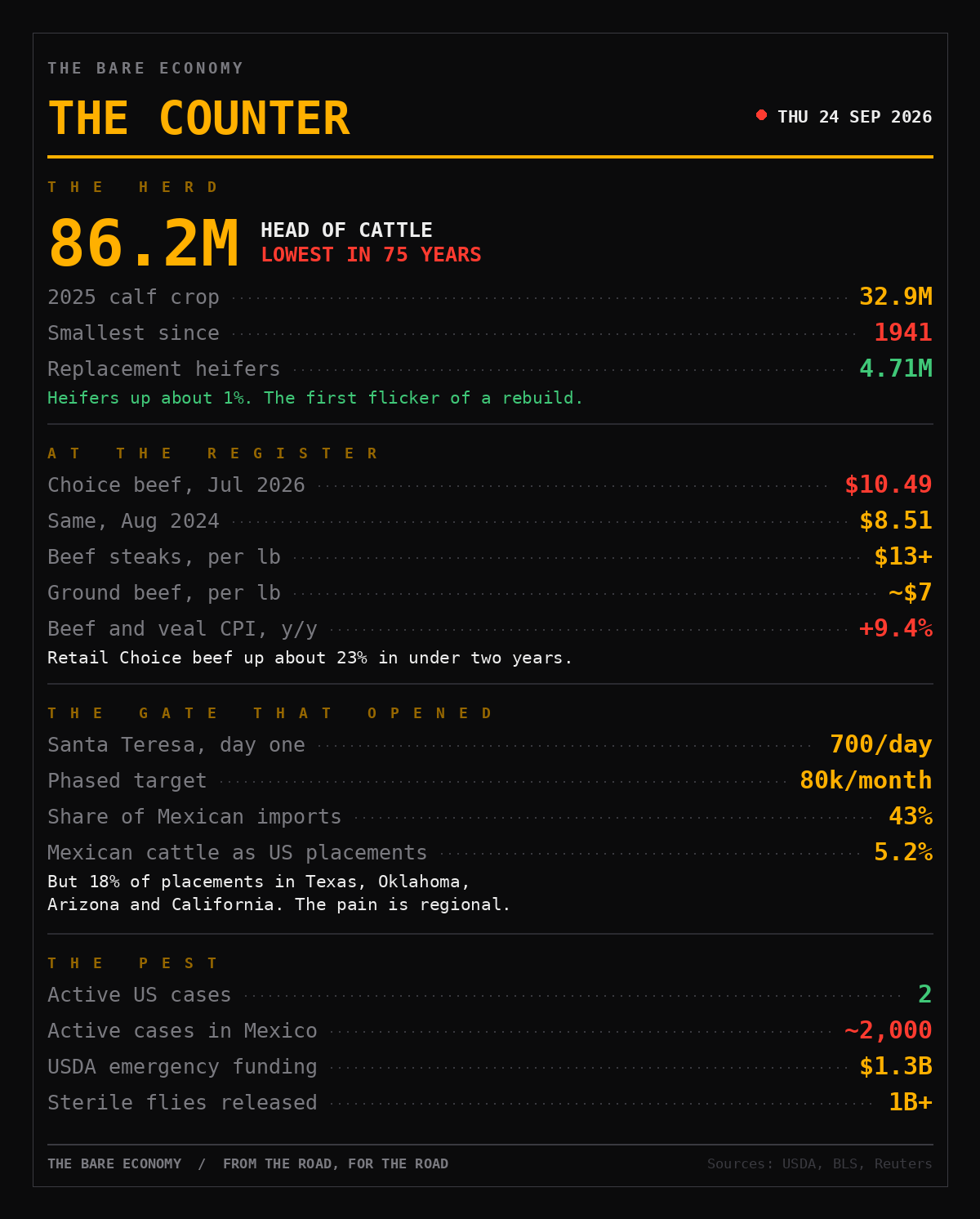
The American cattle herd stands at 86.2 million. That is the smallest it has been in 75 years.
The Breakdown: What Reopened And What Didn't
1. The gate is real and it matters regionally.
USDA wants the phased reopening up to 80,000 head a month. Douglas, Arizona went first on August 24. Santa Teresa is the second.
Mexican feeder cattle averaged about 5.2% of American feedlot placements over the last decade. Nationally that is a rounding error against an 86 million head herd. In Texas, Oklahoma, Arizona and California it was closer to 18% of placements, which is why the Southwest felt the closure like a broken limb.
2. The shortage was never really about the border.
Drought did this. Years of it burned up grass across the West and the Plains, and ranchers sold cows to survive, including the females that make next year's calves.
The 2025 calf crop came in around 32.9 million head, the smallest since 1941. You cannot import your way out of a missing calf crop.
3. The screwworm is not finished.
Two active cases remain in the United States. Roughly two thousand are still running in Mexico.
A new case turned up in a horse in Grant County, New Mexico about 150 miles from this port, confirmed the same day Secretary Rollins announced the reopening date. USDA has spent more than $1.3 billion and released over a billion sterile flies to hold the line.
4. Prices already moved and have not come back.
Retail Choice beef went from $8.51 a pound in August 2024 to $10.49 this July, about 23%. Steaks are north of $13. Ground beef is pushing $7.
The beef and veal index is up 9.4% over the year through July. More than half of shoppers say they have cut back.
The Friction: The Rebuild Makes It Worse Before Better
A calf that crossed this morning does not become dinner this morning. It goes to a feedlot for roughly five months, then to a plant, then through distribution. Call it eight months before it reaches a counter anywhere.
The domestic fix takes far longer, and it runs backward first.
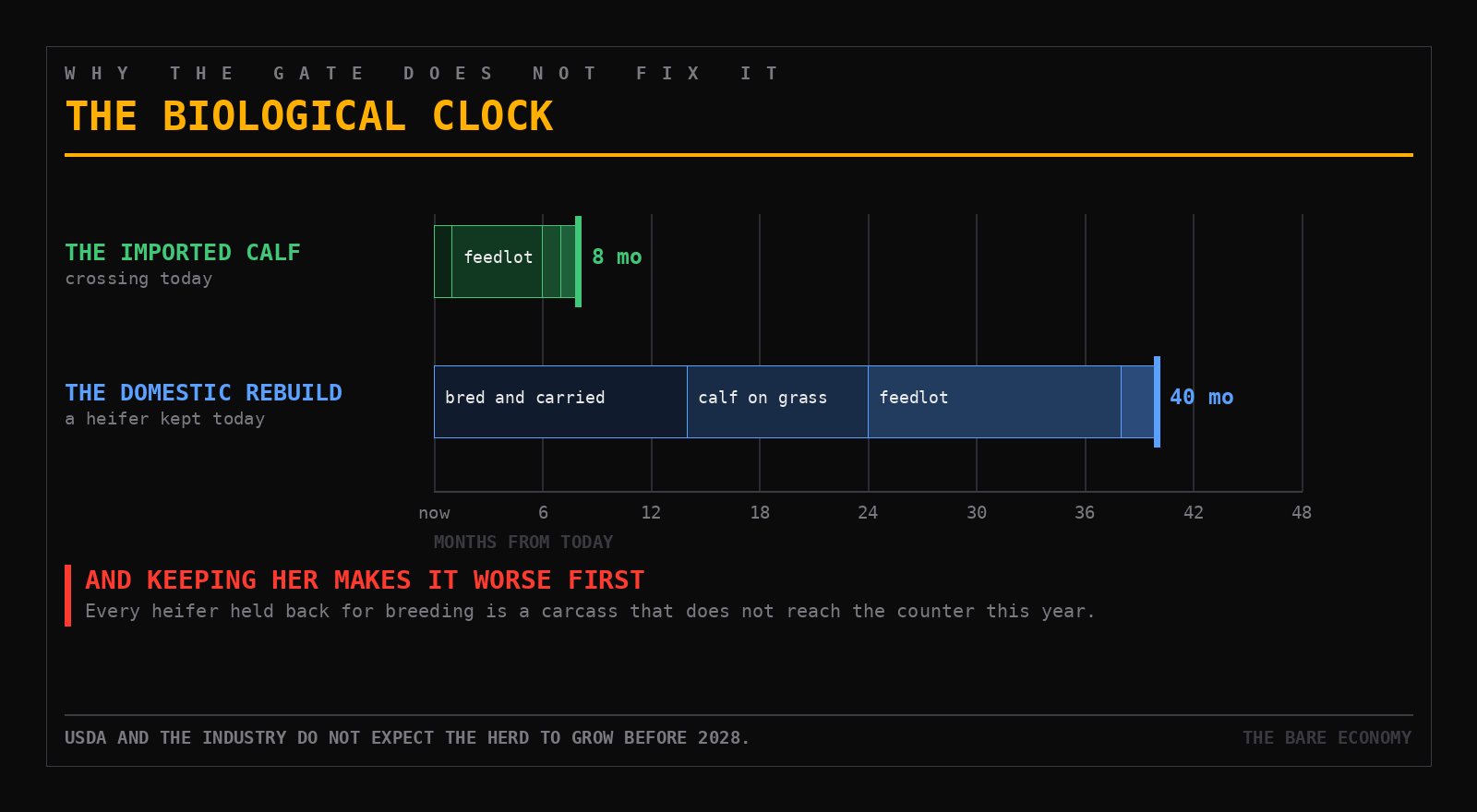
Here is the trap in the cattle cycle. To rebuild a herd, a rancher keeps a heifer instead of selling her. That heifer was going to be beef this year. Now she is not.
So the first year of every recovery tightens supply further and pushes prices up. Replacement heifers ticked up about 1% to 4.71 million, which is the first flicker of a rebuild, and it is also a reason your 2027 grocery bill may not improve.
Record cattle prices make it worse still. When a cow is worth this much at auction, selling her beats breeding her, and plenty of operators are taking the check. USDA and the industry do not expect the herd to grow before 2028. Omaha Steaks' chief executive put meaningful price recovery at 2028 or 2029.
The Macro Extraction
This is what a genuine supply shortage looks like next to a monetary one, and the contrast is worth holding onto. A rate cut cannot make a cow. Neither can a tariff, a border crossing, or an emergency appropriation. Biology sets the schedule and it does not negotiate.
Watch the January cattle inventory report rather than the headlines about ports. Heifer retention in that number is the only real signal that a rebuild has started, and it is the signal that tells you prices stay high for another two years, not that they fall.
For a household, plan on elevated beef through 2027 and treat any dip as weather, not a trend. Ground beef has roughly doubled in a decade and nothing in the pipeline reverses that soon.
And note what the ranchers out here already know. Their diesel is past $6, their equipment and fertilizer cost more, and the animals themselves are the most expensive thing they buy. The man getting rich off record cattle prices is often the man selling the herd, which is precisely why the herd keeps shrinking.
Keep your capital guarded, hold your ground, and stay sharp out there.
— Brook
The Bare Economy. From the road. For the road.