THE BATTERY BELT DIDN'T CLOSE. IT CHANGED CUSTOMERS
Soaring interest rates, 50% insurance spikes, and rent control caps are freezing out individual housing investors while politicians claim to solve affordability.


Washington killed the EV credit and $53 billion went up in smoke. Then the cells found a new buyer, and it is the same one bidding up your electric bill.
JUST IN: The Lights Came Back On. The Job Description Didn't
The parking lot at the Ultium plant off Henn Parkway was empty for seven months. Last month it filled back up.
Fourteen hundred people are making battery cells in Lordstown again, after the line went cold in January and roughly 1,330 of them got sent home.
Ask what changed and nobody here says the electric car came back. It didn't.
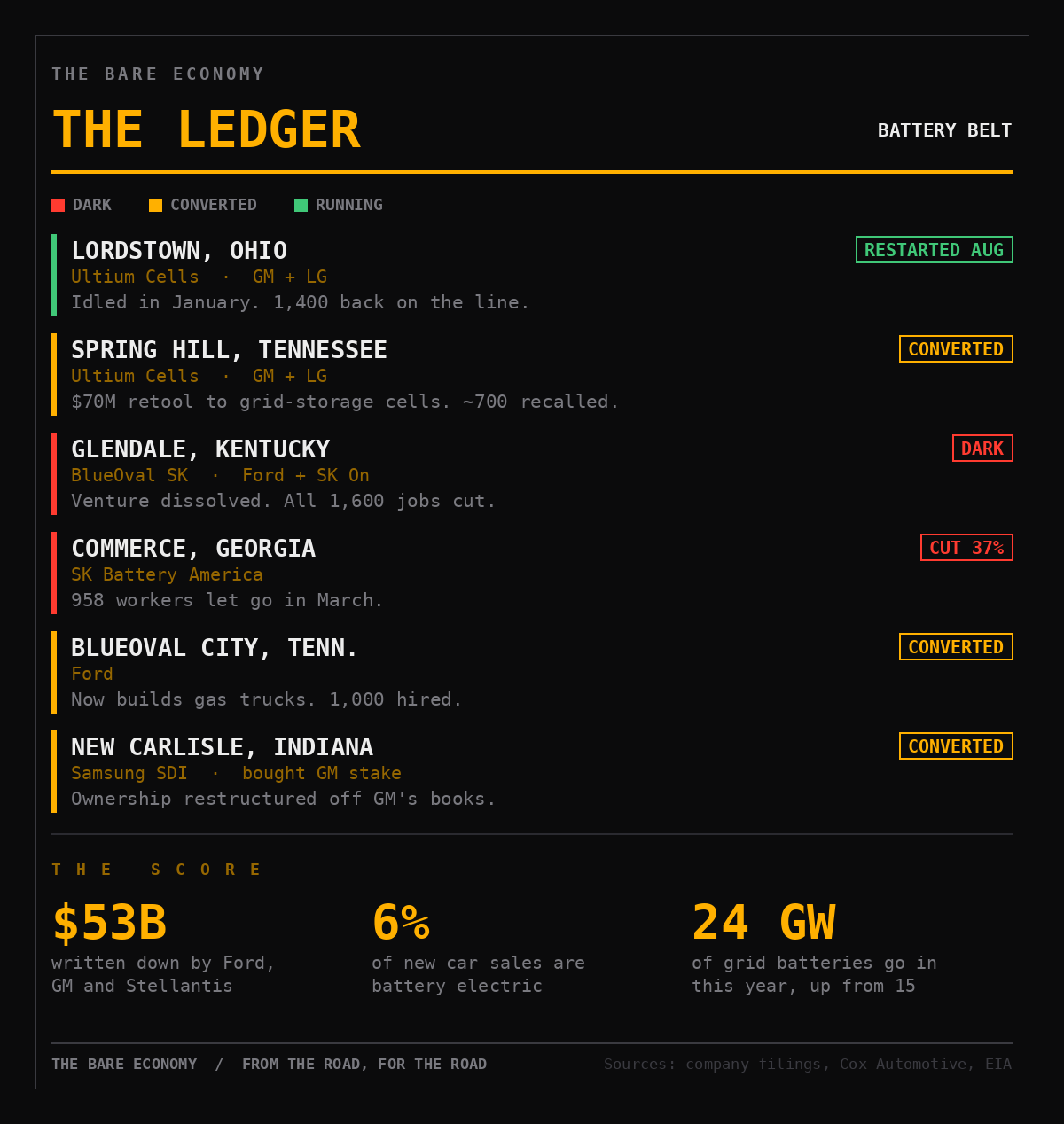
What changed is who buys the cell.
Free Today Only: The Report Wall Street Doesn't Want You To Have (AD)
I need to be upfront with you.
This report normally sells for $97.
Investment firms pay $5,000+ for the same intelligence inside it.
But today — for a limited number of readers — I'm sending it to you completely free.
Here's what's inside:
The Bellweather Signal — 7 warning signs that predicted every major economic collapse since 1929.
Right now, all 7 are flashing red.
I've spent 15 years helping conservative Americans protect their wealth from government overreach and economic manipulation.
After watching millions of hardworking families get wiped out in 2008, I made a promise:
Never again would I let good people get blindsided by a crisis the insiders saw coming.
This report is that promise kept.
Financial newsletters charge $97-$297 for research like this.
Today it's yours free.
But I can only send it to the next group of readers who claim it — after that, it goes back to full price.
Claim your free copy before it's gone →
The Breakdown: A Thesis That Died Faster Than The Concrete Cured
1. The demand shock was a policy shock, and it was instant.
The $7,500 federal credit expired on September 30 last year with no phase-out and no grace period. Battery electrics hit a record 12% of monthly sales that September as buyers sprinted to beat it.
By the next quarter they were 5.7%. Through the first eight months of this year, total EV sales ran about 30% below last year.
2. The write-down is the largest in the industry's history.
Ford, GM and Stellantis have taken roughly $53 billion in EV-related charges between them. GM alone booked $7.6 billion in January, about $6 billion of it tied to Ultium.
Ford dissolved its BlueOval SK venture in December and cut all 1,600 jobs at Glendale, Kentucky. SK Battery America cut 958 at Commerce, Georgia in March, about 37% of that plant.
3. What replaced the electric car was not the gas car. It was the hybrid.
Hybrids hit a record 16% of light-duty sales in the second quarter. Electrified vehicles overall actually grew, from 22% to 24% of the market.
That is the detail that kills the simple story. With gasoline at $4.31 and diesel past $6, Americans did not stop buying efficiency. They stopped buying the plug.
4. The buildings were never really the asset. The cells were.
Spring Hill, Tennessee spent $70 million retooling from EV chemistry to lithium-iron-phosphate for stationary storage, and recalled about 700 workers to build it. Ford's BlueOval City in Tennessee now turns out gas trucks and hired 1,000 people to do it. Samsung SDI bought out GM's stake in the Indiana plant.
Not one of those is a factory going dark. Every one is a factory changing what it sells and to whom.
The Friction: The New Buyer Is The One Raising Your Rates
The cells coming off these lines are going into grid batteries, and grid batteries are going in because the AI buildout cannot get power fast enough.
The EIA expects 24 gigawatts of utility-scale battery capacity to go in this year, up from a record 15 last year. In the primary data center markets the wait for a grid connection now runs past four years, and roughly 30% of planned US data center capacity is arranging its own power behind the meter.
So the Battery Belt found a customer with deep pockets and no patience.
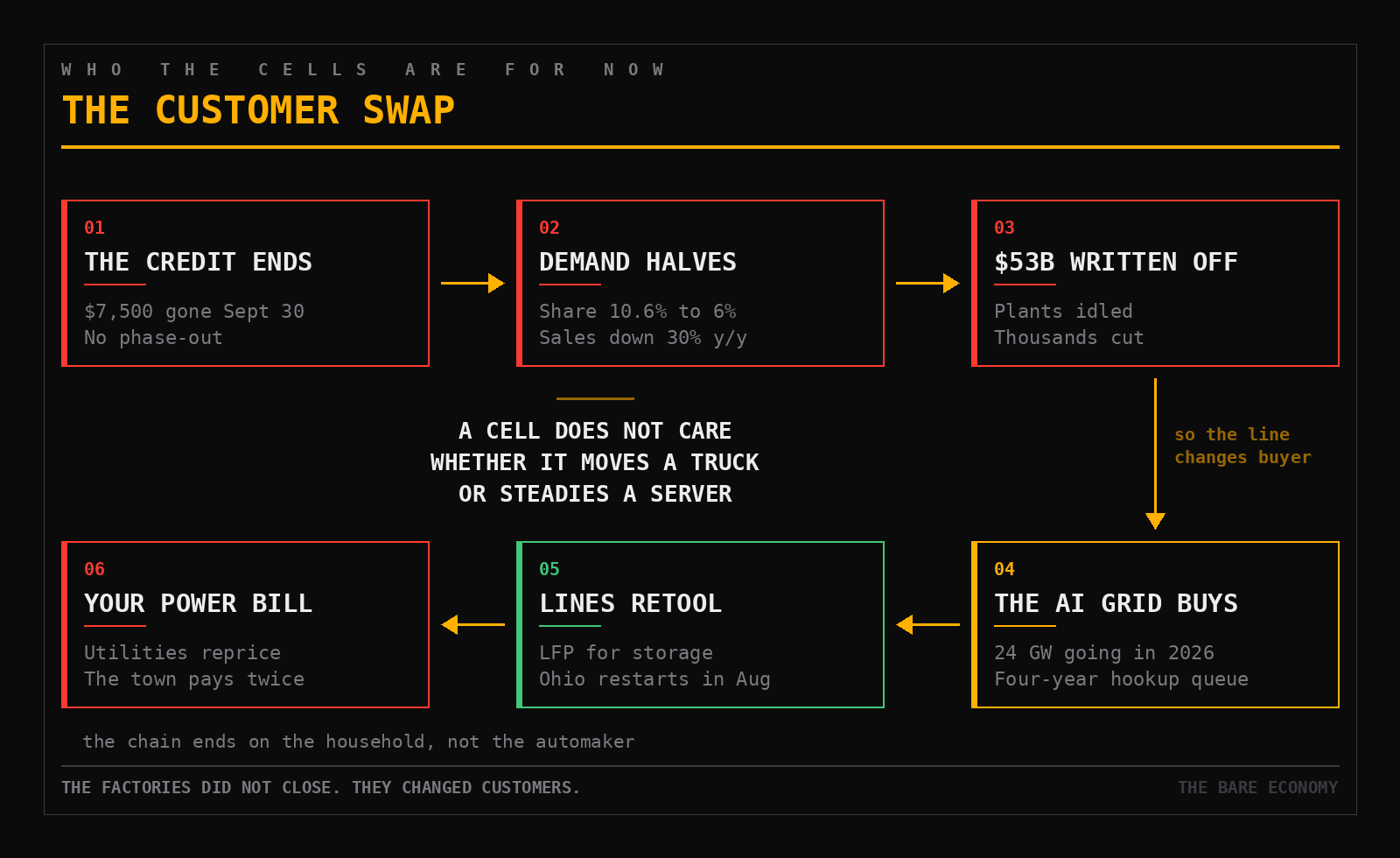
Here is the part the ribbon-cuttings skip. A battery plant serving car buyers and a battery plant serving server farms employ different numbers of people at different wages, and the second one arrives attached to a load that competes with the town for electricity.
Lordstown has been through a version of this before. GM closed the assembly plant in 2019, the battery venture arrived as the answer, and the answer just spent seven months dark.
The Macro Extraction
If you own anything downstream of this, stop underwriting the electric car and start underwriting the electron. The demand that filled these buildings back up is data center load, and that thesis has nothing to do with how many pickups get plugged in next year.
For anyone holding industrial property in Ohio, Kentucky, Georgia or Tennessee, the building did not lose its value. It lost its tenant's business model. A shell built for automotive cells converts to storage cells at a cost measured in tens of millions, which is real money and a long way from a teardown.
The household exposure is the utility bill, and it is the one nobody campaigned on. Every gigawatt of AI load bidding for the same grid shows up eventually in a residential rate case. Watch your next one.
And treat any politician's promise about a factory the way this town learned to. Lordstown has been saved twice in seven years. Check the parking lot, not the press release.
Keep your capital guarded, hold your ground, and stay sharp out there.
— Brook
The Bare Economy. From the road. For the road.