DIESEL BROKE $6 WHILE CRUDE WAS FALLING
Soaring interest rates, 50% insurance spikes, and rent control caps are freezing out individual housing investors while politicians claim to solve affordability.


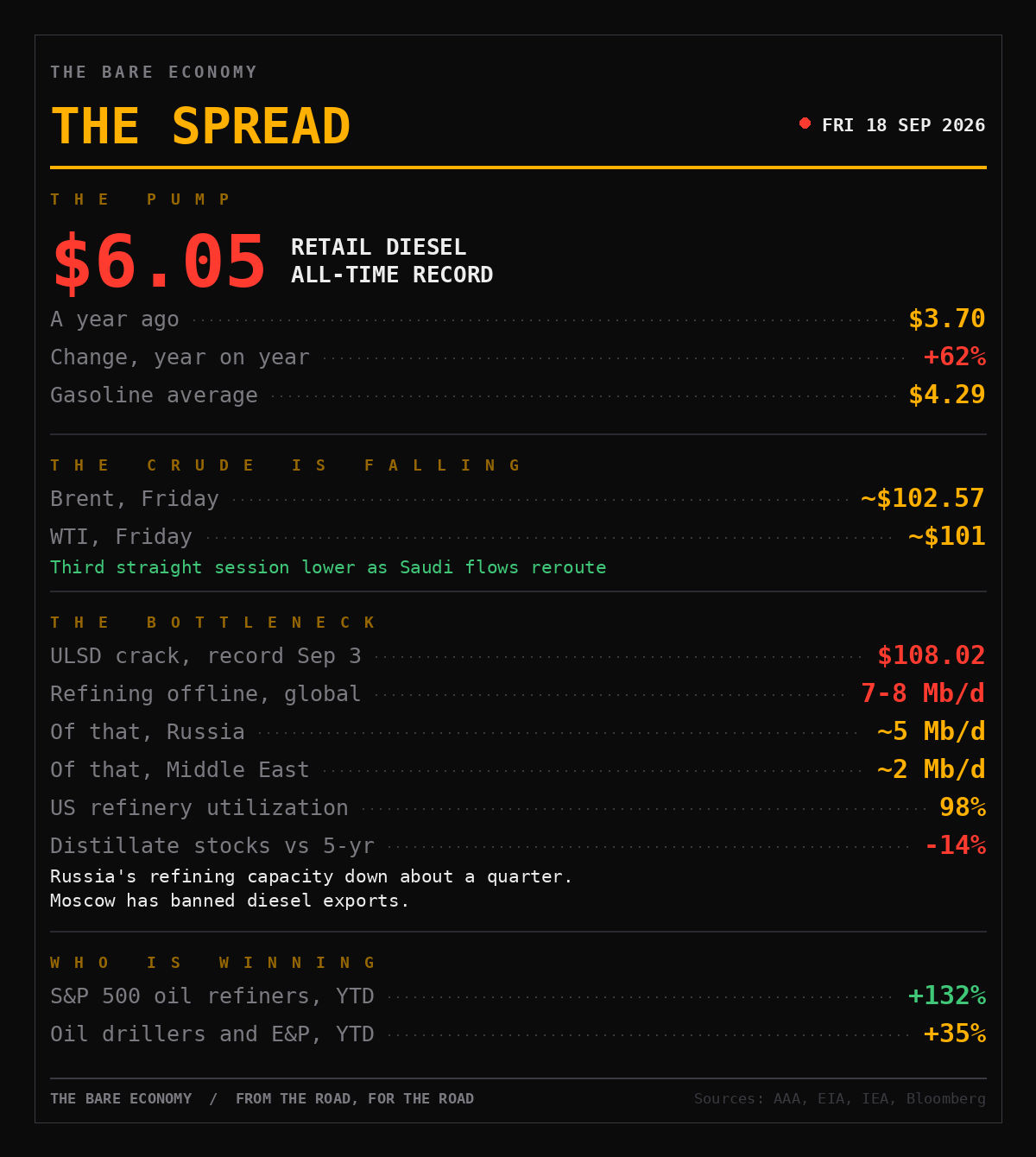
Oil is down three sessions running and the pump just set an all-time record anyway. The bottleneck moved from the oil field to the refinery, and the bill reaches your grocery store around Christmas.
JUST IN: Oil Is Down. The Pump Is At a Record. Both Are True
Brent fell for a third straight session Friday, down to about $102 and change, as Saudi Arabia started pushing crude through Hormuz on shuttle tankers to work around the pipeline it lost last week.
Good news, in theory. The pumps on Fayette Avenue did not get the memo. The board reads $6.34.
AAA put the national average at an all-time record $6.05 on September 11. A year ago it was $3.70.
The United States is not short of oil. It is short of the machinery that turns oil into diesel.
DOJ quietly expands power over personal savings (AD)
The Government Just Said Your Money Isn't Yours — Here's How to Fight Back
What if I told you the government doesn't even consider your money YOUR property?
Sounds crazy, but that's exactly what the Department of Justice just argued in court—claiming cash isn't property, so they can seize it whenever they want.
That's right—According to the DOJ, YOUR hard-earned money isn't legally yours.
Now, think your savings are safe? Think again.
This argument just kicked the door wide open for Washington to freeze bank accounts, confiscate retirement savings, and wipe out wealth overnight.
But you don't have to stand for it.
Because history proves one thing: When governments go broke, they take from the people. It's happened before, and it's happening again.
That's why smart Americans are moving NOW to get their wealth out of the system—before the next financial lockdown hits.
Get your free information kit NOW, before it's too late.
Inside, you'll get the 3 secret strategies you can put in place starting today—so "they" don't control your money tomorrow. Because once the trap is set, it'll be too late to escape.
The Breakdown: The Bottleneck Moved
1. The crack spread tells the whole story.
The margin for turning a barrel of crude into diesel hit a record $108.02 on September 3. It has never been sustained at that level.
When that number goes vertical while crude goes sideways, the shortage is not in the ground. It is in the plant.
2. Somewhere between seven and eight million barrels a day of refining capacity is offline.
Roughly five million of that is Russian, knocked out by Ukrainian drone strikes that have taken out about a quarter of the country's refining capacity. Moscow responded by banning diesel exports.
Another two million is shuttered across the Middle East for the same reason. Global refineries processed 80.9 million barrels a day in July, nearly five million below a year earlier.
3. American refiners cannot fix this, and they are already trying.
US plants are running at 98% utilization, which is the practical ceiling. Distillate stocks still sit about 14% below the five-year average heading into heating season.
Phillips 66's Mark Senn told an industry conference that most US refineries are already flat out. There is no spare capacity to call up. The White House has floated using the Defense Production Act to expand refining, which tells you how few options are left.
4. Compare it to 2022 and the point lands.
The old record was $5.82 in June 2022, set when crude was roughly $28 a barrel more expensive than it is today.
Same pump price, cheaper oil. That gap is the refining shortage, priced.
The Friction: The Part That Hasn't Hit You Yet
Gasoline at $4.29 is what people complain about. Diesel at $6.05 is what actually reprices the country, and it does it on a delay.
About 95% of American carriers run ten trucks or fewer, according to the American Trucking Associations. Those operators cannot absorb a 62% fuel increase for long, and they do not have the contracts to pass it through quickly either.
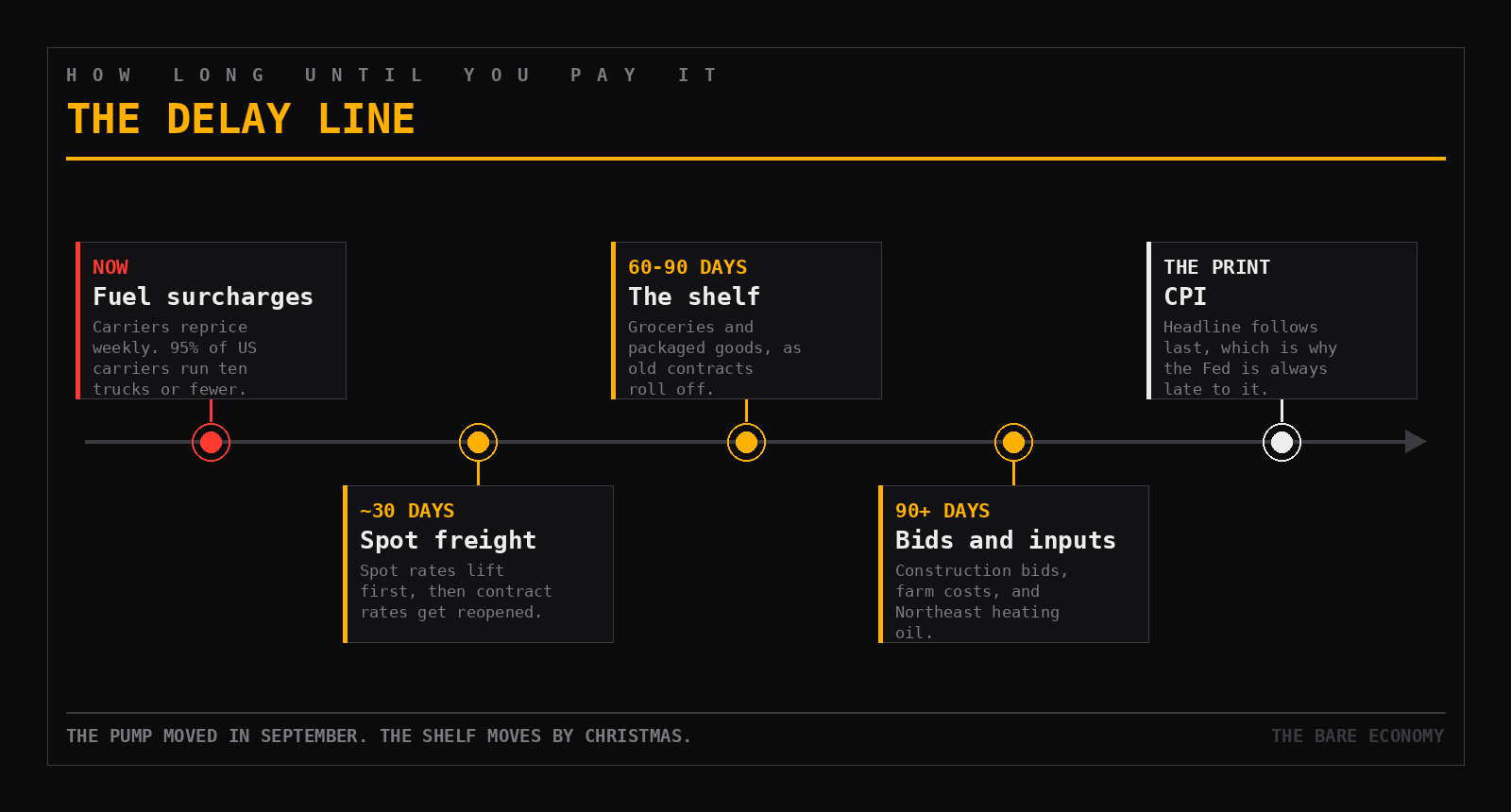
So the squeeze shows up in stages. Surcharges move weekly. Spot freight lifts within a month. Groceries and packaged goods follow when old contracts roll. Construction bids and farm costs land last, along with heating oil in the Northeast.
The Fed sees it after all of that, which is the trap from Wednesday's meeting all over again. Monetary policy cannot build a refinery either.
The honest counter is real. Russia's export ban gets managed month to month and could reverse. Record margins are pulling every refiner on earth toward maximum distillate yield. And demand destruction is visible at $6, which quietly does the work no policy can.
The Macro Extraction
Stop watching the price of crude to guess your grocery bill. It stopped being the right indicator this year. Watch the diesel crack, and watch weekly distillate inventories, because those two decide what the shelf costs in ninety days.
The market has already sorted the winners. Refiners are up 132% this year against 35% for the drillers, and that gap is the entire thesis in one line: owning the bottleneck beat owning the resource. It usually does, and it usually stops working the moment the bottleneck clears.
For a household, the useful move is boring. Heating oil customers in the Northeast should be shopping contracts now rather than in November. Anybody who bids work months ahead, in construction or farming or freight, should be pricing $5-plus diesel as the base case instead of a spike that already passed.
And if you run a truck, you already know all this. The rest of the country is about six weeks behind you and does not know it yet.
Keep your capital guarded, hold your ground, and stay sharp out there.
— Brook
The Bare Economy. From the road. For the road.