AMERICA NOW SPENDS MORE ON SERVERS THAN ON HOUSES
Soaring interest rates, 50% insurance spikes, and rent control caps are freezing out individual housing investors while politicians claim to solve affordability.


Four billion dollars separates the two, and the line that held for the whole postwar era just broke. Here is what it costs you, and what the number does not say.
JUST IN: The Line Broke At Four Billion Dollars
County Road 600 East runs past a corn field, a stalled twelve-lot subdivision with weeds in the footings, and then a graded campus the size of a small town with its own substation going in.
Both of those are American fixed investment. Only one of them is still growing.
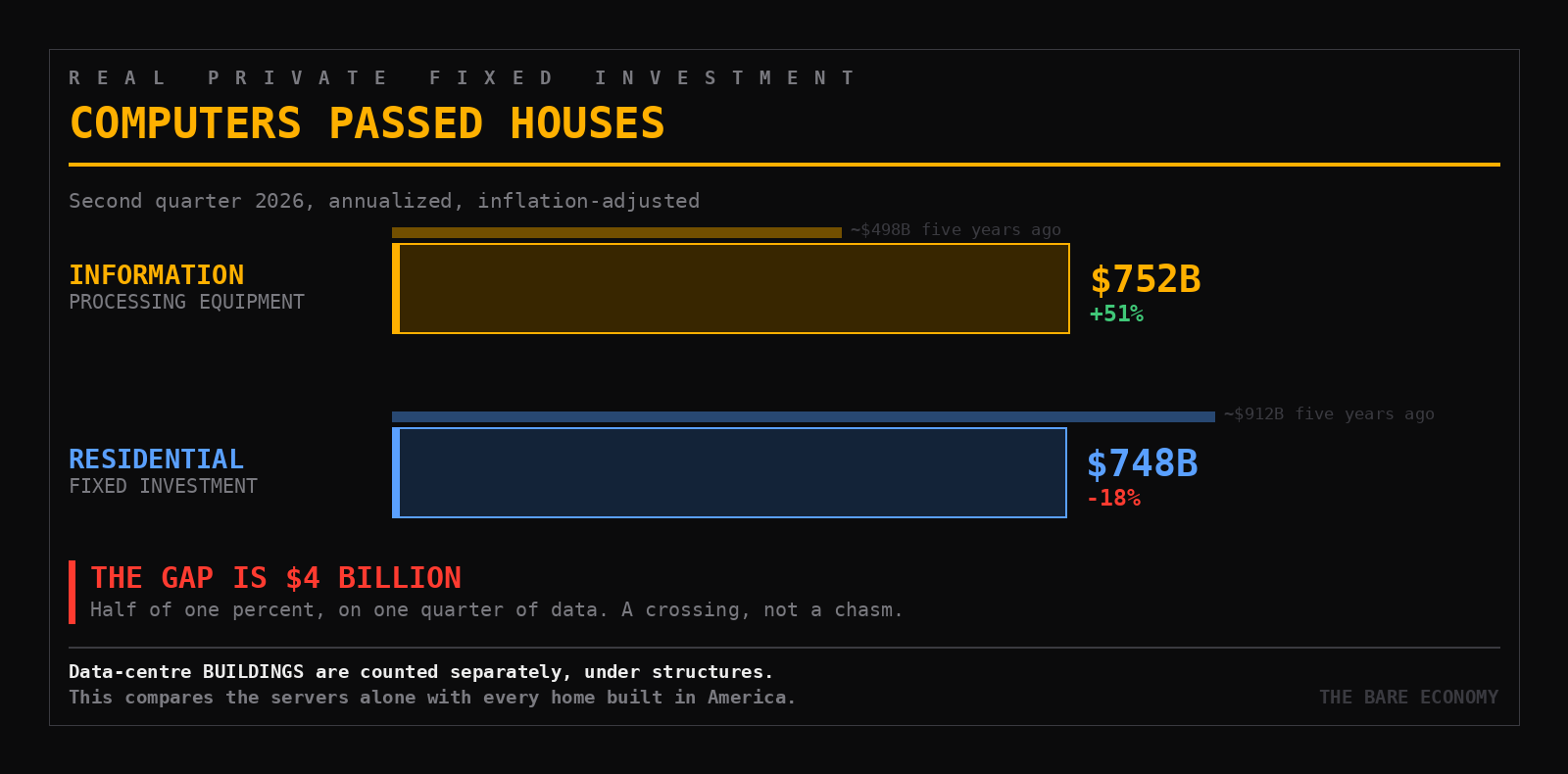
In the second quarter, inflation-adjusted spending on information-processing equipment hit $752 billion. Residential investment came in at $748 billion.
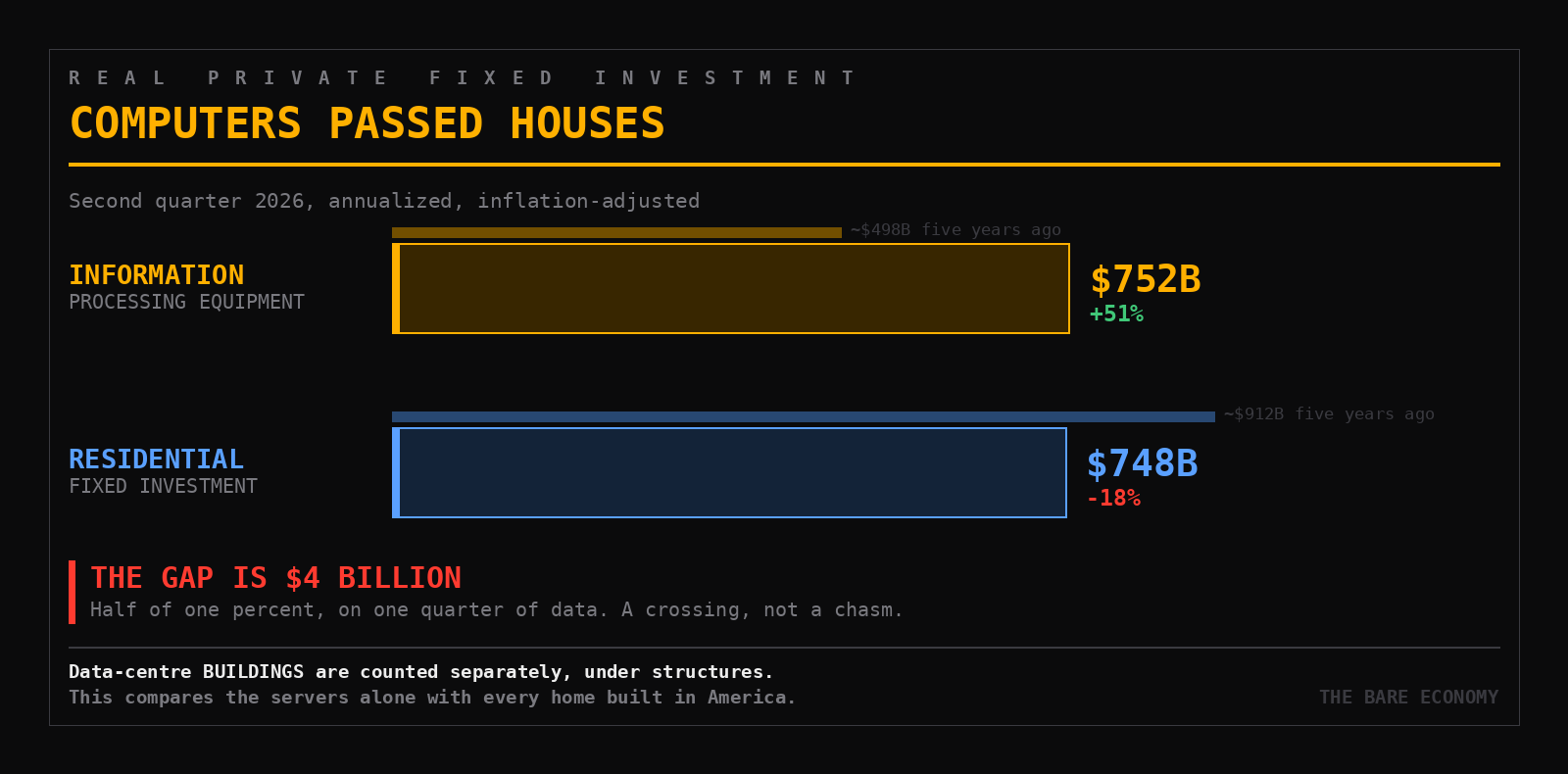
Adam Shapiro, a vice president at the San Francisco Fed, flagged it on LinkedIn. For the first time in the modern record, America is putting more capital into computers than into homes.
This Tesla Demo Shocks Everyone (AD)
"Hi, I'm Jeff Brown...I'm about to get in this Tesla and let it take me a few miles to show you Elon Musk's next Big Project today… What happens next will shock you…"

Click here to see what happened.
The Breakdown: What The Number Says And What It Doesn't
1. The crossing is real, but it is narrow.
Four billion on a base of seven hundred fifty is half of one percent. It is one quarter of data, inflation-adjusted, and the revisions are not in.
Treat it as a line being crossed, not a chasm opening. The direction is the story, not the margin.
2. It is a scissors, not a surge.
Housing did not just lose a race. It fell 18% from its early-2021 peak, its fifth straight quarterly decline. Over the same stretch, information-processing equipment climbed 51%.
Half the move is the boom. The other half is the freeze.
3. The category actually understates the buildout.
Information-processing equipment means the servers, the network gear, the hardware. The buildings those servers sit in are counted somewhere else entirely, under nonresidential structures.
So this compares the machines alone against every home, apartment and renovation in the country. Add the concrete and the gap gets wider.
4. The spending is accelerating, and it is not paying for itself yet.
S&P Global puts combined capex from Alphabet, Amazon, Microsoft, Meta, Oracle and SpaceX at roughly $870 billion this year, above $1.3 trillion by 2027, against $470 billion in 2025.
The same analysis expects those six firms to run collectively negative operating cash flow across 2026 and 2027, with capex outrunning revenue until an inflection somewhere in 2028.
The Friction: One Rate, Two Economies
Wednesday's hike took the funds rate to 3.75%–4.00%, and the dot plot still leaves room for one more this year. The 30-year mortgage sits around 7%.
Housing is the most rate-sensitive thing in the economy because buyers borrow every dollar, and a monthly payment is a rate before it is a price. Roughly half of American owners hold a mortgage below 4%, so almost nobody lists.
Compute does not flinch at the same number. Hyperscaler capex comes out of operating cash and equity first, and when it does get borrowed, it now gets borrowed against the chips themselves, the way that $22 billion Crux AI facility was written.
That is the whole asymmetry. Warsh can cool what borrows. He cannot cool what pays cash.
Worth saying plainly: this is not proof of a bubble. Microsoft and Google are running capacity-constrained, the compute demand is real, and one quarter is one quarter. What it is proof of is scale, because the number now shows up in the same national accounts we use to track housing and consumer spending.
The Macro Extraction
Understand what this does to the shape of a recession. Housing used to be the cycle. It led down, it led back up, and it employed framers and electricians in every county in America. That engine is now idling and something with a fraction of the payroll has taken over as the growth driver.
A server farm that costs a billion dollars employs a few dozen people once the crews go home. A billion dollars of houses employs a town. Same GDP contribution, completely different county.
For your own balance sheet, the line to watch is that negative operating cash flow. As long as the six biggest spenders are funding this out of pocket, the buildout absorbs shocks internally. The moment it leans on borrowed money to keep the pace, it starts living on the same 5% long end that already froze housing, and then the two stories become one story.
Out here that debate is a substation going up behind a subdivision that never got framed. Both were somebody's plan. Only one got financed.
Keep your capital guarded, hold your ground, and stay sharp out there.
— Brook
The Bare Economy. From the road. For the road.