$22 BILLION LENT AGAINST CHIPS THAT AGE LIKE MILK
Soaring interest rates, 50% insurance spikes, and rent control caps are freezing out individual housing investors while politicians claim to solve affordability.


Ten banks just wrote the biggest chip loan yet, secured by the silicon itself. The plan is to sell it to your bond fund before anyone finds out what the silicon is worth in year four.
JUST IN: The Collateral Is The Chip
Out past the roundabout on Beech Road the transformers are stacked four high behind chain link, waiting on a hookup that takes years to get.
That is the real bottleneck out here, and it is the reason a deal like yesterday's exists at all.
Ten banks are lending $22 billion to Crux AI, the cloud venture Blackstone and Alphabet launched in May, to buy Google's tensor processing units. There is a separate $1 billion revolver on top. Blackstone has $5 billion of equity underneath it.
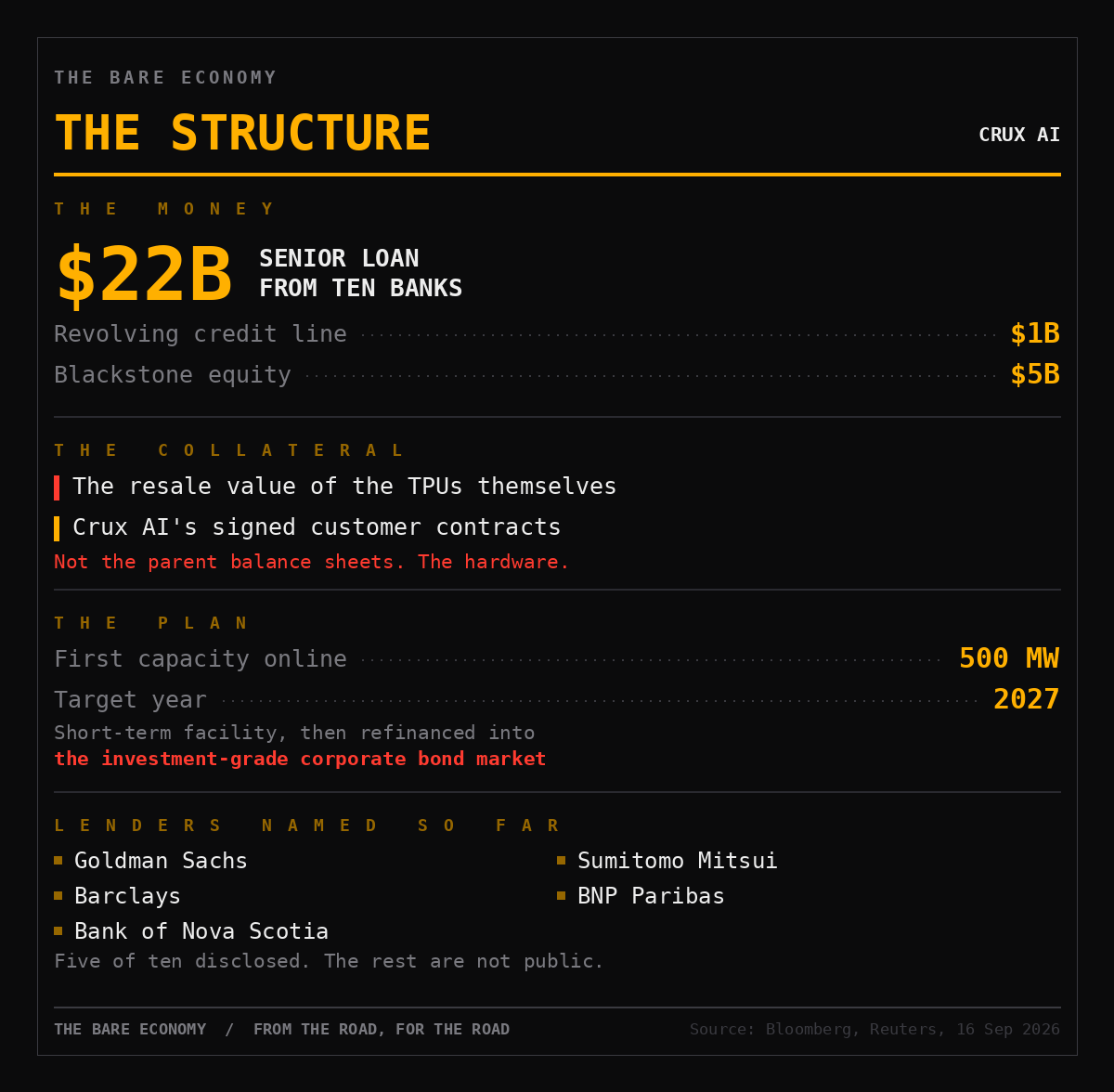
The loan is not secured by Blackstone. It is not secured by Alphabet. It is secured by the resale value of the chips and by Crux AI's customer contracts.
The Breakdown: Project Finance For Things That Go Obsolete
1. This is the template, not the exception.
Apollo and Blackstone arranged $35 billion for Anthropic to lease TPUs in a deal supported by Broadcom. A second one on the same structure is in discussion with more than $60 billion on the table.
In August, Nvidia signed memoranda with Apollo, BlackRock, Blackstone, Brookfield, Goldman Sachs and KKR aimed at mobilizing over $500 billion. Goldman described the goal as building a credit market backed by Nvidia compute.
2. Blackstone is on every side of this table.
Equity in Crux. Lender to Anthropic. Signatory to the Nvidia framework. CoreWeave's 2023 chip-backed loan was led by Magnetar and Blackstone too.
That is not illegal and it is not hidden. It is concentration, and concentration is what turns one bad quarter into everybody's bad quarter.
3. The collateral has no agreed shelf life.
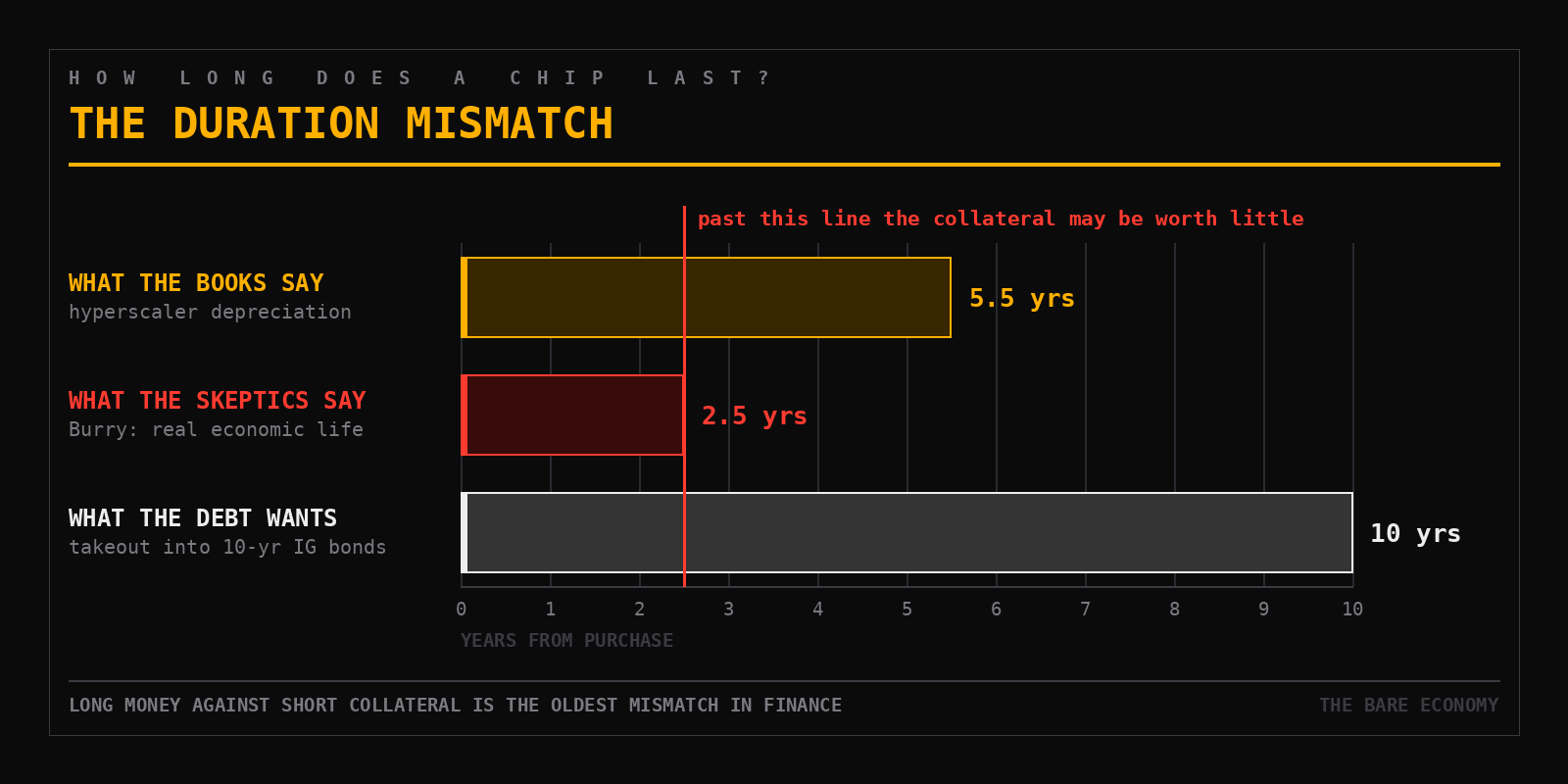
Hyperscalers depreciate accelerators over four to six years. Meta stretched certain servers to 5.5 years starting in fiscal 2025 and cut its depreciation expense by about $2.9 billion that year.
Michael Burry puts real economic life at two to three and figures the gap understates industry depreciation by roughly $176 billion across 2026 to 2028. Even Jensen Huang has conceded the resale problem, saying that once Blackwell shipped in volume, you couldn't give the older Hoppers away.
4. Crux is already slipping.
Bloomberg reported last week that the project has hit delays at major data center sites meant to run these chips.
The clock on a chip's value starts when it is bought. The revenue starts when it is plugged in. Every month between those two dates is burned collateral.
The Friction: The Part Where It Becomes Yours
Read the exit plan carefully, because it is the whole story. The bank facility is short-term, and the intention is to refinance it into the investment-grade corporate bond market.
Translated: ten banks that can price this risk hold it now, and pension funds and bond index funds hold it later.
Wall Street expects something near $300 billion of AI-related investment-grade issuance this year. That is roughly the same paper that has been crowding out Treasuries and helping push the 10-year to 5%.
You do not need to own a single chip stock to be in this trade. If you own a total bond market fund, you are already being handed the tail.
The honest counter is that the demand has shown up so far. Big tech capital spending is tracking toward $1 trillion in 2027, used A100s and H100s still clear at real prices, and old accelerators keep earning on inference work. Nobody has been through a full chip cycle yet, because the buildout is three years old.
The Macro Extraction
Go look at what your bond fund actually holds. Not the ticker, the sector weights. Investment grade is not a description of the collateral, it is a rating on the borrower, and the fastest-growing slice of new issuance now sits on hardware with a contested expiry date.
If you hold the AI names in equity and a broad bond fund in the safe sleeve, you do not have two positions. You have one position twice, and the bond sleeve was supposed to be the thing that saved you when the first one broke.
The tell to watch is not Nvidia's revenue. It is the secondary market for last-generation accelerators. If mid-life chips keep clearing at decent prices, the loans are fine and the structure works. If that bid thins out, every one of these deals reprices at once, because they are all written against the same assumption.
Out here it looks like transformers behind a fence and a substation nobody voted on. On a bank's book it is an asset class. Those are the same thing, which is what makes it worth watching.
Keep your capital guarded, hold your ground, and stay sharp out there.
— Brook
The Bare Economy. From the road. For the road.