🚨 ALERT: The BofA number nobody quoted
Soaring interest rates, 50% insurance spikes, and rent control caps are freezing out individual housing investors while politicians claim to solve affordability.


$450 billion in noncancelable obligations against $16.3 billion of half-year revenue. It’s going public because nothing else can carry it.
JUST IN: A $6.9 BILLION QUARTER THAT GOT CALLED A FAILURE
Barron’s ran a piece this morning asking whether it’s time for a new chief executive at Bank of America. The bank earned $6.9 billion in three months. Both of those sentences are fair.
I read the earnings release instead of the opinion piece. The number that stopped me was not the fine and not the trading miss.
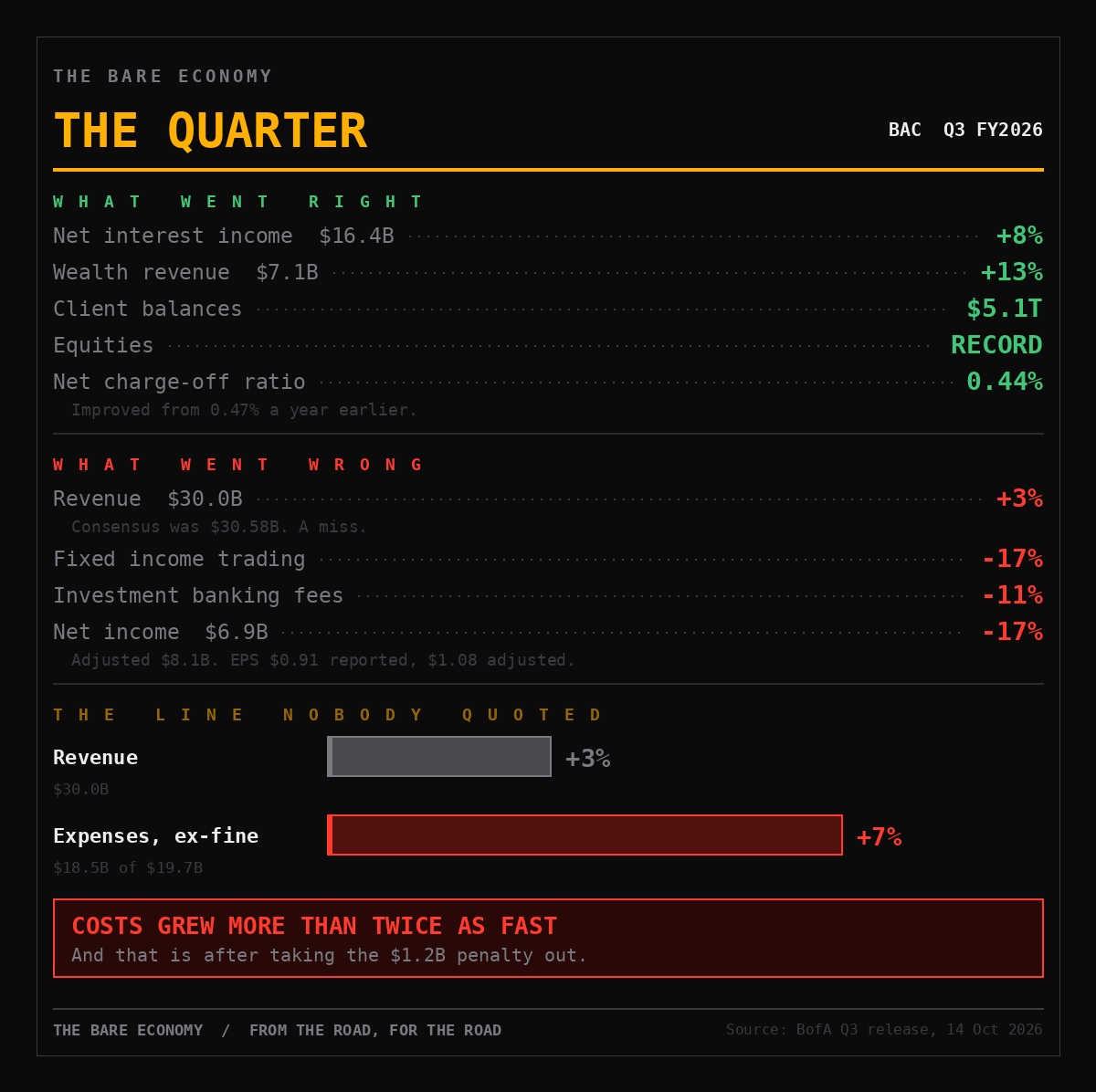
Strip out the $1.2 billion regulatory charge and costs still grew more than twice as fast as revenue. That is the whole argument, and almost nobody printed it.
How to get a pre-IPO stake in Anthropic (AD)
Venture capitalists call a private company worth over $1 billion a unicorn.
$10 billion and it’s a decacorn.
$100 billion is a hectocorn.
But what do you call a private company worth over a trillion dollars?
Anthropic is there, right now.
The first of its kind.
It’s worth more than every American airline — combined.
It’s even bigger than the U.S. defense budget …
Anthropic’s annualized revenue grew by 80 times in the first quarter.
They’ve already filed the paperwork for an IPO …
Some estimates say they are going public as early as November.
Now, here’s what’s really exciting.
You can take a stake in this IPO …
Right now.
Today.
Before it goes public.
For a chance to see gains on day one.
Click here to find out how.
THE BREAKDOWN: THREE DIFFERENT COMPLAINTS WEARING ONE HEADLINE
1. The trading miss is not a firing offense and anyone saying otherwise is reaching. Fixed income fell 17% because rates moved hard and clients stopped transacting, in credit, mortgages and municipals. That happened to everyone. In the same quarter, equities put up a record and were up 10%. Net interest income rose 8%. Charge-offs improved. You do not remove a chief executive because bond desks had a quiet September.
2. The expense line is a real question, and it is his. Revenue up 3%, costs up 14%, or roughly 7% once you take the penalty out. Negative operating leverage is the one thing a bank CEO is unambiguously responsible for, because it is the part that does not depend on the market. The comparison that stings: operating margin has averaged about 21.9% since 2022, against roughly 29.9% at JPMorgan.
3. The compliance failure is the only charge that actually goes to the job. Regulators identified significant deficiencies in 2023. A formal cease-and-desist order landed in December 2024. The problems continued past it, and FinCEN concluded the violations were willful. More than $5 billion in suspicious activity went unreported on time, over $1 billion of it tied to national security risk. That is not a market cycle. That is a control that stayed broken for three years after someone official wrote it down.
4. Here is the defense, and it is stronger than the critics allow. He took the job in 2010 holding Countrywide and Merrill Lynch and a balance sheet plenty of people thought would not survive the decade. He spent years paying out legal settlements that ran past $100 billion and rebuilding capital from nothing. Today: CET1 at 10.9%, charge-offs at 0.44%, $5.1 trillion in wealth balances. And the JPMorgan comparison cuts both ways, because JPMorgan is arguably the best-run bank on earth. Being worth less than Jamie Dimon’s bank is not evidence of failure. Almost everyone is.
The AI fund that pays you every Thursday (AD)
've just found a way to collect $1,051 in a single month from artificial intelligence stocks.
Not from selling shares. Not from trading options.
Just from owning one small fund, and letting it deposit cash into my account every Thursday.
That's a 34% annualized distribution rate from AI stocks that pay no dividends.
I recorded a full presentation explaining exactly how this works...
And how you could collect your first payout as soon as this Thursday.
Watch the free presentation here.
THE FRICTION: WHICH COMPLAINT IS ACTUALLY ABOUT THE JOB
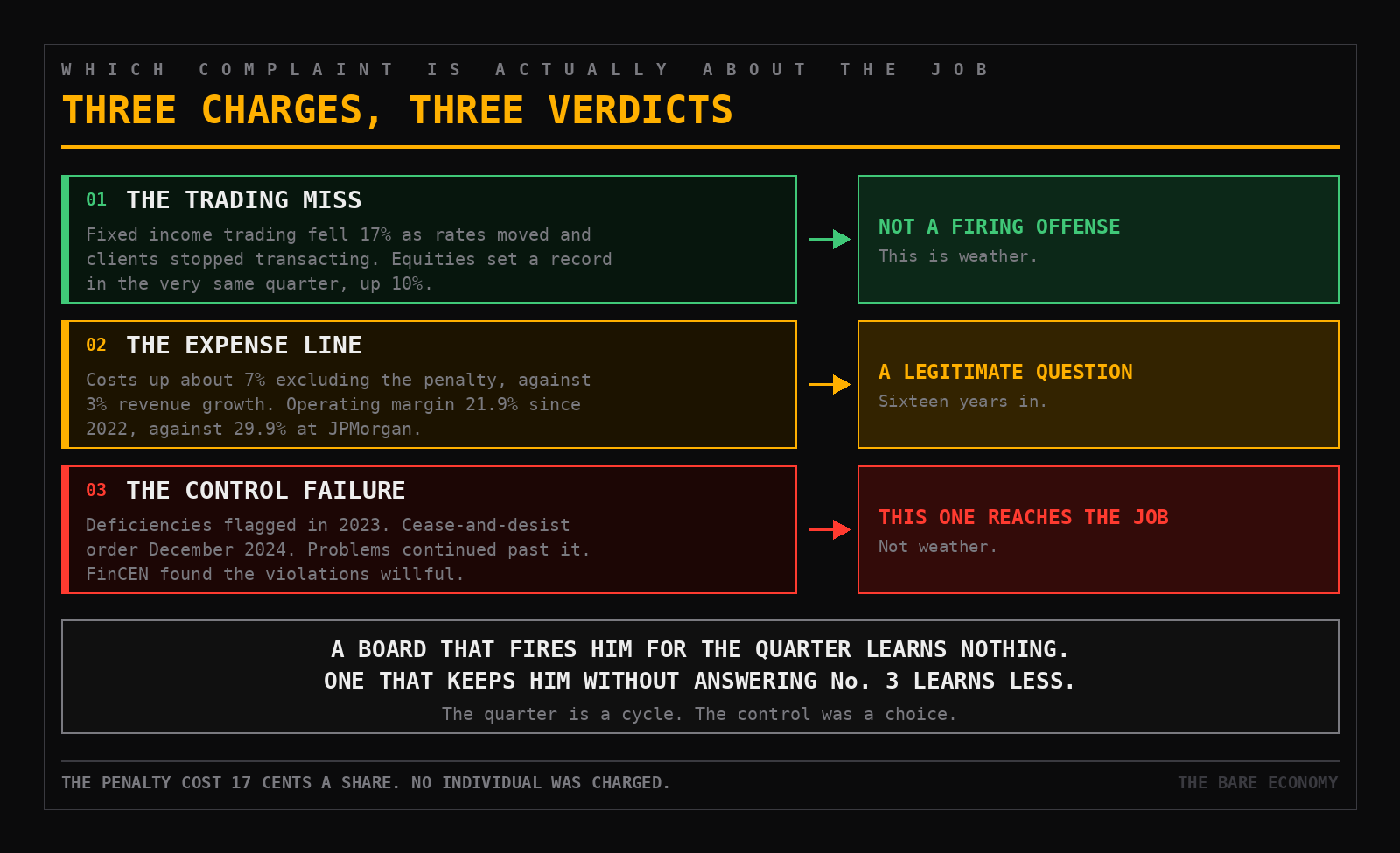
Most of the commentary this week is about a bad quarter. A bad quarter is weather.
Number three is not weather. Number three is a question about whether anybody inside that building could make a thing happen after the government wrote it down twice.
THE MACRO EXTRACTION
Morgan Stanley kept its Overweight and trimmed its target to $61 from $67, which on a $51 stock still implies a decent move. It cut the target multiple to 11.5 times from 12.25. Its phrase was that the stock looks “closer to being de-risked.” That is analyst for: we think the bad news is out, mostly, probably.
The shares are down about 5% on the year, total return. The bank trades near 11.4 times forward earnings against JPMorgan’s 13.5. That gap has been there for years. It is not a reaction to October. It is the market’s standing opinion of the franchise, renewed quarterly, for a long time.
Here is my problem with the whole conversation.
The penalty was $1.2 billion. It cost 17 cents a share and the stock absorbed it inside a week. The executive compensation went $27.8 million, then $35 million, then $41 million across roughly the same stretch of years the control was failing. No individual was charged with anything.
So the accounting works out like this. The institution pays, the shareholders take 17 cents, nobody loses a job, and the lesson arrives as a line item in a quarter that still cleared $6.9 billion.
Meanwhile the rules that failed upward at $5 billion in unreported transactions are enforced with total precision on a guy at the counter in this building trying to deposit cash from selling a truck. He gets the form. He gets the wait. He gets asked where it came from.
That is not an argument for firing anyone. It is an observation about who the compliance system is actually built to inconvenience.
Whether the board moves is their business. The question worth asking out loud is simpler: after sixteen years, what exactly would have to go wrong for the answer to be yes?
— Brook
The Bare Economy. From the road. For the road.
Do not ignore. The damage is done. (AD)
The damage is done.
I know that's not what you want to hear.
You want to hear that the conflict in Iran is winding down but wanting the moon won’t bring it down to you.
As I explain in this new documentary, the truth is this: even if the war ends today, the damage is done … the consequences for the markets will take years to resolve… and the shockwaves are about to unleash a new crisis here in America.
While politicians can shake hands and proclaim that the war is over, the reality is the decimation of the Persian Gulf’s energy infrastructure can’t be fixed with a “deal.”
A peace treaty can’t rebuild a liquefied natural gas (“LNG”) facility that took 14 years and $50 billion to build… and all across the Middle East, energy infrastructure has been decimated.
Qatar's Ras Laffan facility handled about 100 million tonnes of LNG per year, nearly a third of the entire global supply. It has been destroyed.
The CEO of QatarEnergy, Saad al-Kaabi, said publicly that repairs will take "three to five years." Three to five years. That's not a political problem. That's an engineering problem.
Saudi Aramco's Ras Tanura, the world's largest offshore oil loading terminal, was hit. Iran's own South Pars gas field, the largest natural gas field on the planet, has been struck.
Oil infrastructure across the region that took decades and hundreds of billions of dollars to construct has been laid to waste.
The International Energy Agency, the same body that has tracked every oil crisis since 1973, issued an alarming statement:
"The war in the Middle East is creating the largest supply disruption in the history of the global oil market."
That’s because this time it’s physical.
Consider the embargo of 1973, that was political and could be reversed with a deal. Or the Iranian Revolution of 1979, which disrupted production but left infrastructure intact.
This time, the infrastructure is rubble.
And the devastation cannot be undone with a “deal.”
Yet I fear that not enough people are pricing in what comes next.
In my new video I lay out what the global oil shock means for America… and, most importantly, what you can do to get on the right side of the coming financial shock.
Watch my video message now before it’s too late.