The Price of Cheap Groceries: Independent Grocers Take City Hall to Court
Soaring interest rates, 50% insurance spikes, and rent control caps are freezing out individual housing investors while politicians claim to solve affordability.

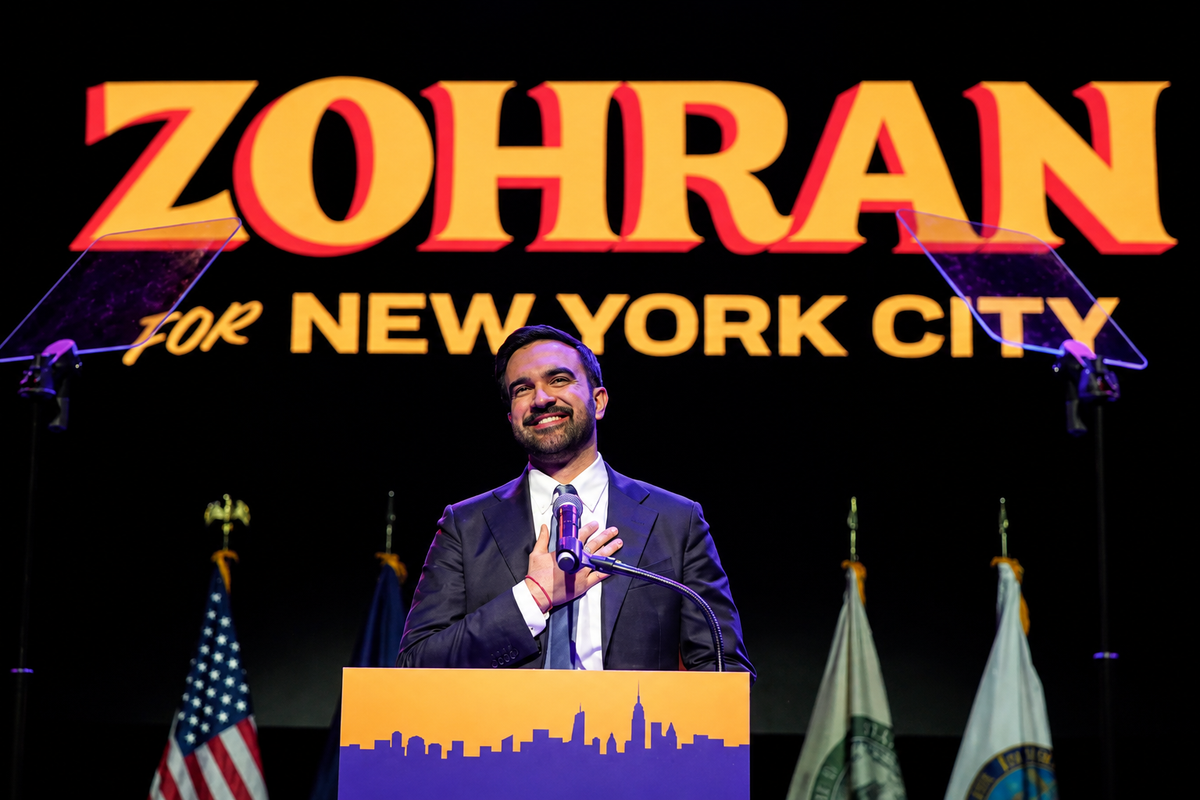
Inside the legal war breaking out over New York City’s $70 million municipal supermarket experiment.
🗺️ Current Dispatch: East Harlem, New York City
⛽ Local Diesel: $4.29/gal
☕ Diner Coffee Index: $4.50 — black, paper cup. 6.5/10.
The tension between government intervention and private market survival just boiled over onto the pavement of New York City.
A coalition representing hundreds of independent, minority-, and immigrant-owned supermarkets and local bodegas filed a pair of major class-action lawsuits in New York County Supreme Court against Mayor Zohran Mamdani and the city. The core challenge targets City Hall’s flagship $70 million initiative to build five municipally owned, city-subsidized grocery stores across the five boroughs—one in each borough, starting with Hunts Point in the Bronx.
The legal offensive sets up an explicit clash: an aggressive municipal effort to lower the cost of living confronting small business owners who argue that government-subsidized competition threatens their existence.
The Policy Blueprint: Five Municipal Supermarkets
Mayor Mamdani’s plan centers on leveraging city funding to directly lower retail food prices for working-class New Yorkers facing systemic cost-of-living pressures after years of compounding food inflation.
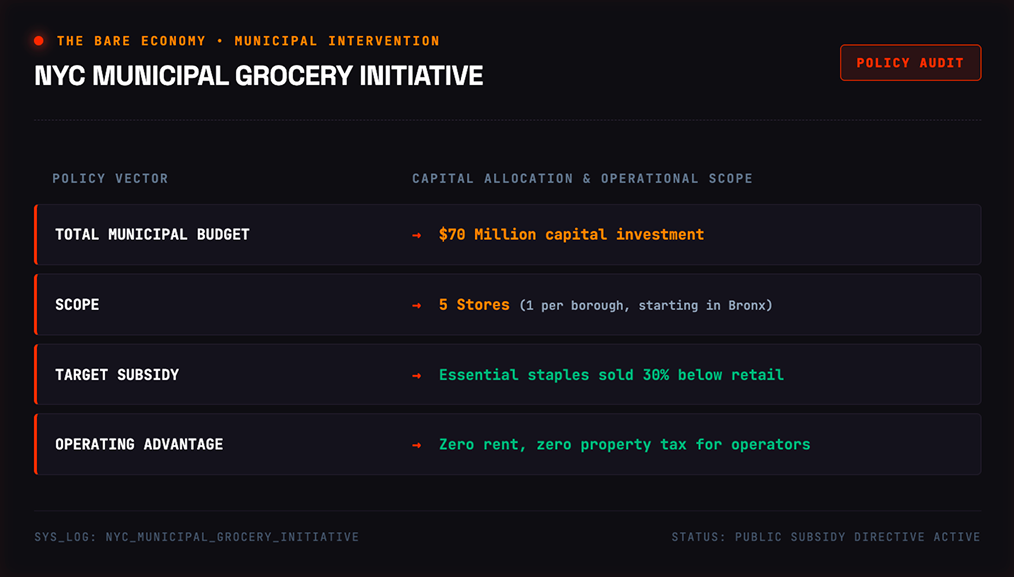
Under the administration’s outline, the New York City Economic Development Corporation (NYCEDC) plans to contract private operators to run the locations through a competitive Request for Proposals (RFP) process.
By eliminating commercial real estate rents, property tax obligations, and utility overhead for the operators—while injecting a direct municipal operating subsidy—the city aims to offer a core basket of everyday staples (fresh produce, meat, dairy, eggs, and bread) at prices roughly 30% below market rates. City Hall projects this could save participating households over $1,000 annually.
Message from the sponsor:
RYSE's $2.50 share price changes August 31
If you've been considering an investment in RYSE, there's one date to know:
August 31.
That's when RYSE says its current $2.50 share price is set to change.
RYSE has already sold more than 100,000 devices, generated over $20 million in revenue, and raised $15 million+ from more than 4,000 investors.
The smart-home company has developed patented technology that turns existing window coverings into automated, AI-ready systems without requiring homeowners to replace their shades.
And 92% of window shades are still manually controlled.
RYSE is currently offering shares through its Regulation A+ offering, with bonus shares available on qualifying investments.
If RYSE has been on your radar, August 31 gives you a reason to take a closer look now.
SEE THE RYSE INVESTMENT OPPORTUNITY BEFORE AUGUST 31 →
Important disclosures. This is a paid advertisement for RYSE Inc. made pursuant to a Regulation A+ offering and involves risk, including the possible loss of principal. The valuation is set by the Company; there is currently no public market for the Company's Common Stock. Nasdaq ticker "$RYSS" has been reserved by RYSE; any potential listing is subject to future regulatory approval and market conditions. Past share-price appreciation does not guarantee future returns. SEC qualification does not constitute SEC approval of the merits.
RYSE Inc., 96 Spadina Avenue, Suite 500, Toronto, ON M5V 2J6, Canada
The Lawsuit: Unfair Competition & Lack of Economic Study
The legal challenge, led by the Multicultural Business Coalition (MBC)—an organization representing Asian, Black, Hispanic, Middle Eastern, and Jewish business leaders and independent grocers—argues that the city is effectively weaponizing public tax dollars to undercut private small businesses.
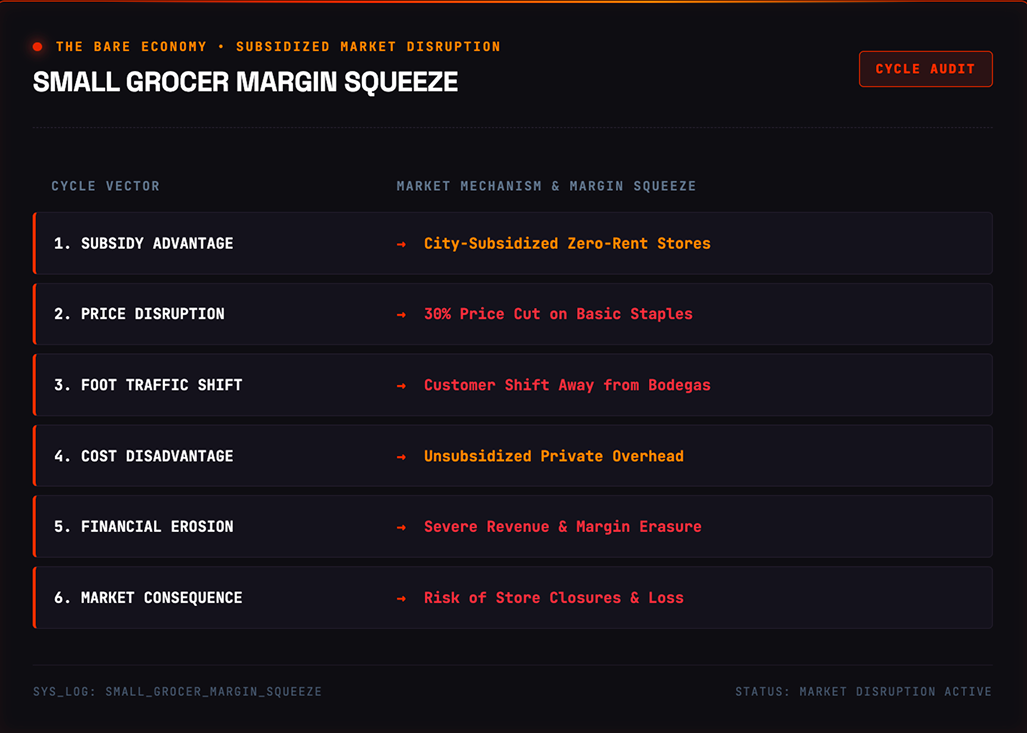
Key arguments raised in the court filings include:
- Asymmetric Competition: Private grocers must absorb escalating commercial rents, Con Edison utility bills, and commercial liability insurance. Competing against a municipality-backed competitor operating without rent or property tax burdens makes survival mathematically impossible for nearby independent shops.
- Lack of Mandatory Impact Studies: The lawsuit alleges the administration failed to perform environmental or economic impact reviews to measure how municipal grocery locations will affect existing mom-and-pop stores operating within the immediate radius.
- Civil Rights & Disproportionate Impact: Because the vast majority of NYC's independent bodegas and neighborhood supermarkets are operated by immigrant and minority entrepreneurs, the coalition contends the policy unfairly threatens the economic footing of historically disadvantaged small-business owners.
Attorneys for the grocers likened the scale of the state-backed 30% price cuts to allowing major hyper-discount mega-retailers into NYC neighborhoods without local review, warning it will drive neighborhood grocers out of business.
City Hall’s Counter-Defense
Responding to news of the lawsuit during a press conference, Mayor Mamdani stood firm on both the legal authority and economic necessity of the program.
The administration’s defense rests on three main pillars:
- Scale vs. Market Density: In a city of 8.5 million residents with over 1,000 independent grocery stores, City Hall argues that five targeted municipal outlets will not dismantle the broader private market.
- Historical Precedent: The city points to existing subsidized markets—such as the Essex Street Market in Manhattan and the Moore Street Market in Brooklyn—as proof that city-supported food hubs can exist without bankrupting adjacent private bodegas.
- Mitigation Efforts: NYCEDC officials announced they are evaluating tax abatements, zoning relief, and regulatory streamlines to help private, minority-owned grocers lower their internal costs.
Message from the sponsor:
Why taking RMDs like this is a big mistake
Most retirees forced to take RMDs are shocked to read this…
According to Forbes…
“Required minimum distributions… do not have to be taken in cash.”
(Who knew?!)
But why is that important?
Because when someone takes their RMDs in cash…
They’re instantly setting themselves up for…
Immediate taxes
Advisor fees
The “Silent Tax”... Inflation
All unnecessary and easily offset by knowing one thing…
How to strategically take Required Minimum Distributions so you can…
Keep more of your retirement savings and wealth.
A new guide explains all the details.
Including how IRS Code 408(m) helps investors…
Leverage the tax laws to get full value from their RMDs.
Without the extra fees or missing out on market upside.
While preserving wealth so it can grow uninterrupted long term.
Go here for details…
The Macro Extraction
The NYC grocery dispute highlights a fundamental economic dilemma shaping urban policy: when government intervenes directly to shield consumers from persistent inflation, it runs the risk of disrupting the private micro-economies that sustain neighborhood commerce.
Lowering everyday food prices for working families is a critical objective, but doing so via subsidized direct competition risks displacing the independent grocers who anchored these same communities for decades.
Watch the court proceedings closely—the ruling will set a national legal precedent for how far municipal governments can go in running public-option retail enterprises.
Keep your balance sheet clean, protect your margins, and stay sharp out there.
— Brook
The Bare Economy. From the road. For the road.