Concrete, Megawatts, and Local Bills: Wall Street’s AI Blind Spot.
Soaring interest rates, 50% insurance spikes, and rent control caps are freezing out individual housing investors while politicians claim to solve affordability.

Private equity is underwriting decades of data center demand, but local politics runs on 2-year election cycles. Here is the view from the pavement.
Trading the quiet asphalt of Big Sky country for the claustrophobic grid of Manhattan for a couple of days. Down here on Wall Street, the narrative around artificial intelligence is clean, exponential, and purely financial.
Capital is pouring into data center operators, regional energy providers, and utility vendors. On the private equity and public ticker screens, everything points up and to the right.
But as Dan Primack at Axios highlighted this week, there’s a massive blind spot developing right under the feet of the institutional money men: the politics on the ground.
While Wall Street looks at 20-year demand curves, statehouses and local town boards are looking at next Tuesday's voter sentiment.
The Disconnect: Capital vs. The Ballot Box
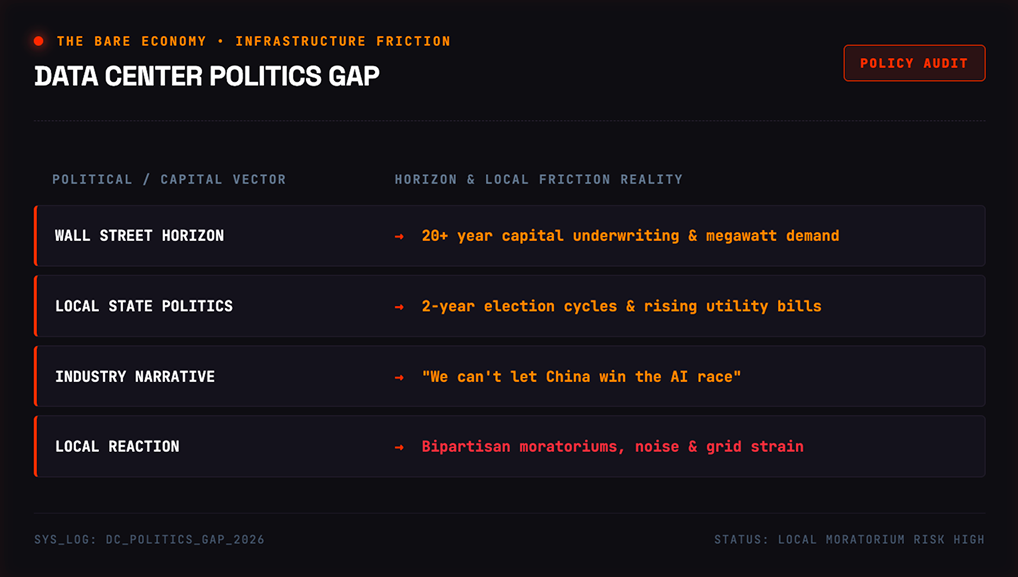
Across the country, the political mood toward massive data center developments has turned sharply negative—and it’s cutting across party lines. A growing list of state legislatures and county boards are pushing through moratoriums, axing tax incentives, or outright banning new site builds.
Inside the boardrooms, developers often brush off local opposition as a simple "community education issue," convincing themselves that pushback will vanish once election cycles pass.
They are missing the mark:
- The Geopolitical Pitch Fails on Main Street: Pitching "we have to beat China in AI" doesn't mean a thing to a family in Virginia or Georgia whose residential electricity rates just jumped 20% to cover regional grid upgrades.
- Resource Strain Is Local: Data centers consume immense amounts of water for cooling and hog massive regional megawatt capacity. When a rural community sees their local resources locked up for a warehouse full of server racks that creates fewer than twenty permanent local jobs, resentment builds fast.
- The Time Horizon Mismatch: As one Wall Street executive put it, capital is underwriting decades of infrastructure demand, but politics runs on a two-year clock. Those two timelines rarely reconcile quietly.
The Macro Extraction
You can't code your way around a power grid, and you can't private-equity your way past a angry zoning board.
The next bottleneck for the AI trade isn't going to be chip supply or capital—it’s going to be local political friction. When institutional money assumes infinitely smooth execution and meets local regulatory brick walls, project delays stack up, capital gets trapped, and projected returns take a haircut.
Watch where the power gets built, watch who pays for the transmission lines, and don't assume the electorate will foot the bill for the cloud.
I'm wrapping up meetings here in the city and getting ready to turn the rig back toward the open road.
Keep your eyes on the horizon, protect your balance sheet, and stay sharp.
— Brook
The Bare Economy. From the road. For the road.